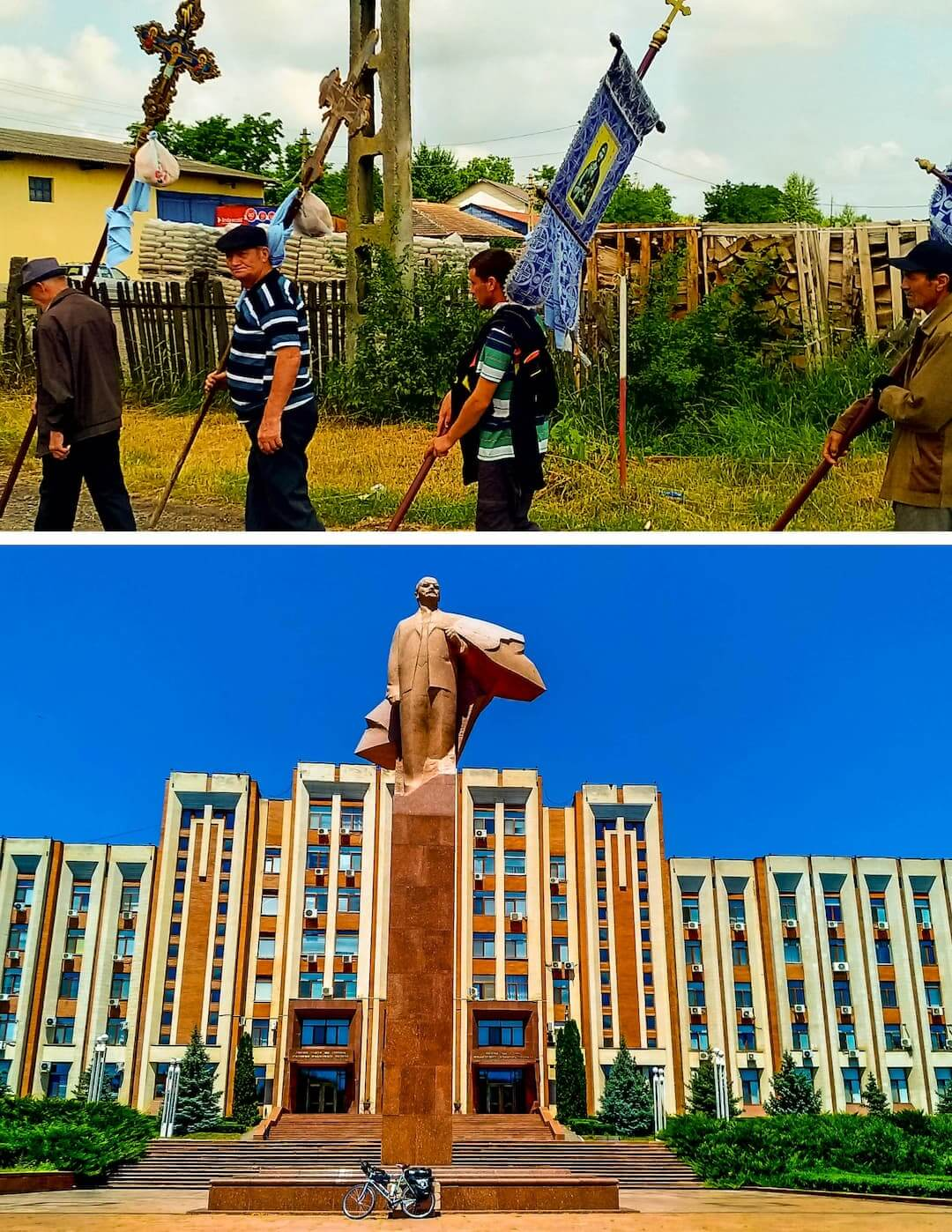
Somewhere between Botoșani in northeastern Romania and Rîșcani in Moldova, I passed a funeral procession moving through a small village.
Men in everyday clothes carried tall wooden crosses and blue Orthodox banners bearing sacred images. Pieces of cloth and small plastic bags had been tied to the crosses. The procession moved past modest houses, rough wooden fences, stacked building materials, and the concrete utility poles so characteristic of villages across this part of Europe. One of the men turned and looked directly at me as I took a photograph.
I knew nothing about the person who had died. The bereaved family and the coffin were somewhere beyond the frame. I was simply a cyclist passing through, my journey intersecting for a few moments with the most solemn event in the life of a village.
Such encounters are among the reasons I travel by bicycle.
From a car, I might have slowed briefly or passed without fully understanding what I was seeing. On a bicycle, there is little separation between the traveler and the life along the road. You hear voices, notice faces, smell woodsmoke and newly cut grass, and feel the texture of a place beneath your wheels. Nothing is arranged for your benefit. A funeral procession, a roadside shrine, a village well, or an old woman returning from a field enters the journey without explanation and then disappears behind you.
The road from Prague to Odessa was filled with such moments. It crossed countries, but even more significantly, it passed through historical borderlands where identities have overlapped for centuries and where the past has never been entirely settled.
Riding East from Prague
Leaving Prague, the route initially passed through a world familiar to me: across Bohemia to Hradec Králové, then eastward to Olomouc and Zlín in Moravia. From Zlín, where the cycling stages in my original book formally began, I continued into Slovakia through Dubnica, Prievidza, Zvolen, and Rimavská Sobota.
The landscape changed gradually rather than dramatically. That is one of the revealing qualities of crossing a continent by bicycle. Political borders may be marked by signs, abandoned customs posts, or a change in road surface, but the deeper transitions unfold slowly. Architecture changes from village to village. Church towers take on different forms. Languages on shop signs alter, sometimes almost imperceptibly. Food, road manners, and the condition of houses begin to tell a different story.
From southern Slovakia, I crossed into Hungary near Kazincbarcika and continued toward Tokaj. The town is known internationally for its wine, but on a long cycling journey it also represented a pause before the route turned farther east. I stayed long enough to make a circular ride to Boldogkő Castle, standing dramatically above the countryside, before continuing through Nyírbátor and toward the Romanian border.
At Satu Mare, the route entered a region where the map becomes a lesson in the instability of European history. Hungarians, Romanians, Slovaks, Ukrainians, Jews, Germans, Roma, and other communities have lived across these borderlands, sometimes together and sometimes under competing empires and national governments. Borders moved while villages remained in place. A person could be born in one country, live in another, and die in a third without ever leaving home.
The bicycle carried me through these layers without offering a simple way to separate them.
Maramureș and the Carpathians
From Satu Mare, I rode north and east toward Săpânța and Sighetu Marmației, entering Maramureș. Here, villages still seemed closely tied to the surrounding land. Wooden houses, carved gateways, hayfields, orchards, roadside crosses, and church spires gave the region a distinctive character.
The route then turned through the Carpathians: from Sighetu Marmației to Săcel, Cârlibaba, Câmpulung Moldovenesc, Rădăuți, and Botoșani.
These were not merely mountains to be crossed. The Carpathians form one of Europe’s great cultural divides, but also one of its meeting places. Valleys that appear isolated on a modern road map were once part of trading routes, imperial frontiers, and shifting political worlds. Maramureș and Bukovina still retain the feeling of regions with identities older and more complex than the countries that now contain them.
Cycling through them, history did not appear as a sequence of dates. It appeared in the mixture of architectural styles, the forms of worship, the village cemeteries, and the differing ways people cultivated and occupied the land.
Beyond Botoșani, the terrain opened toward Moldova. It was there, on the way to Rîșcani, that I encountered the funeral procession.
The photograph stayed with me because it contained no famous monument and no spectacle. It showed a community carrying out an ancient ritual along an ordinary village road. The crosses and Orthodox banners represented a tradition that had survived invasions, political upheavals, changing borders, and decades during which religion was officially discouraged or suppressed under Soviet rule.
The past was not displayed behind museum glass. It was walking through the village, carried on the shoulders of men in striped shirts, jackets, caps, and worn trousers.
Across Moldova
From Rîșcani, I continued south, spending one night wild camping before reaching Chișinău. Moldova is often passed over in descriptions of Europe, as though it were merely a space between Romania and Ukraine. On a bicycle, no country can remain an abstraction. Its scale becomes physical. Every hill must be climbed, every settlement entered, every kilometer of broken pavement or open countryside crossed under one’s own power.
Beyond the capital, I rode east toward Tiraspol and crossed into Transnistria.
Transnistria occupies a peculiar place both geographically and historically. It functions separately from Moldova while remaining internationally recognized as part of it. Soviet symbols that disappeared from much of Eastern Europe remain conspicuous there. The atmosphere in Tiraspol seemed to belong not entirely to the present but to a political world that had survived beyond its expected time.
Nothing expressed that more forcefully than the monumental Lenin standing before the Supreme Council building.
Erected in 1987 for the seventieth anniversary of the October Revolution, the statue is a theatrical figure in red granite, its immense cape appearing to flutter behind it. Lenin towers above a broad pedestal, with the symmetrical government façade spreading across the background. The entire composition projects permanence, order, and authority.
I leaned my loaded touring bicycle against the base of the monument and stepped back to take a photograph.
The bicycle looked almost comically small beneath Lenin. It had accompanied me from Prague across Bohemia, Moravia, Slovakia, Hungary, Romania, and Moldova. It represented movement, improvisation, and a journey freely chosen. Above it stood a monumental expression of an ideology that had once sought to determine the course of history itself.
The government building behind the statue appeared as cold as the monument. Its broad steps were empty. No one walked in or out. There was none of the everyday activity one might expect around the seat of a government. Apart from the rows of air conditioners attached to the façade, the building offered little evidence that it was occupied at all.
My bicycle seemed to be the only living presence in the photograph.
Yet I was not alone.
While I stood facing the monument with my camera, soldiers and passing locals were behind me, watching. I felt their cold looks but did not dare turn around and point the camera toward them. Photographing the Lenin monument was one thing. Photographing those who were observing me seemed likely to cross an unspoken boundary.
There was no confrontation and no questioning. Nothing happened. Nevertheless, the moment carried an unmistakable tension. The scene in front of my lens was empty, but from beyond its frame I was being watched.
The contrast with the village funeral could hardly have been greater. There, one of the men carrying a cross had turned and met my camera directly. The photograph was filled with people, religious symbols, and the untidy evidence of daily life. In Tiraspol, the people watching remained invisible. The photograph contained stone, symmetry, clipped hedges, empty steps, and an immense political monument.
Strangely, it was in the empty square that I felt most observed.
In the Moldovan village, the past moved slowly along the road, carried by ordinary people. In Tiraspol, it stood immovable on a granite pedestal. One tradition had survived the Soviet attempt to suppress it; the other had survived the disappearance of the Soviet Union itself.
Toward the Black Sea
From Tiraspol, I rode onward into Ukraine, continuing through Biliaivka and then toward the Black Sea coast at Zatoka. From there, the final stages led through Sanzhiika and eventually into Odessa.
After weeks of riding eastward across the interior of Europe, reaching the sea had a particular emotional force. A continental journey acquires its own momentum. Each day advances toward a destination that remains imaginary until the landscape finally opens and the horizon changes. The Black Sea was no longer a shape on the map at the far end of my route. It was physically before me.
Odessa was a fitting destination. It has always been a city of arrivals and departures, a Black Sea port shaped by commerce, migration, ambition, cultural mixture, and political upheaval. Reaching it by bicycle from Prague made the city feel connected to everything behind me: the ordered landscapes of Central Europe, the valleys of Slovakia, the vineyards of Tokaj, the villages of Maramureș and Bukovina, the rolling countryside of Moldova, and the preserved Soviet world of Transnistria.
The journey had crossed several national borders, but the deeper experience was one of passing through overlapping Europes.
There was the Central Europe of Prague, Moravia, and the former Habsburg lands. There was the mountainous, village-centered world of the Carpathians. There were regions in which Romanian, Hungarian, Slavic, Jewish, German, and other histories had accumulated over centuries. Farther east lay territories shaped by the Russian Empire, the Soviet Union, disputed identities, and borders that still did not feel final.
From an airplane, Prague and Odessa are merely two cities separated by a few hours. Even on a map, the route appears as a line extending eastward. From the saddle, however, that line became a succession of human landscapes.
The funeral procession and the Lenin monument remain two of the journey’s most expressive images. Neither was the reason I set out for Odessa. Neither had been marked as a destination on my route. Yet together they revealed something essential about the lands through which I was traveling.
History there was not safely concluded. It survived in faith and ritual, in architecture and political symbols, in the arrangement of villages and the silence of government squares. It lived in the man who turned toward my camera while carrying a cross, and in the unseen soldiers whose attention I felt behind me as I photographed Lenin.
Between those two moments, my bicycle carried me steadily eastward—through the borderlands of Europe and, finally, to the Black Sea.
** Cycling to Odessa: Journey Across Eastern Europe PDF; and the same original title in paperback at Amazon.
For related subjects, read Cycling Prague to Athens: Where Does Europe Begin? essay.