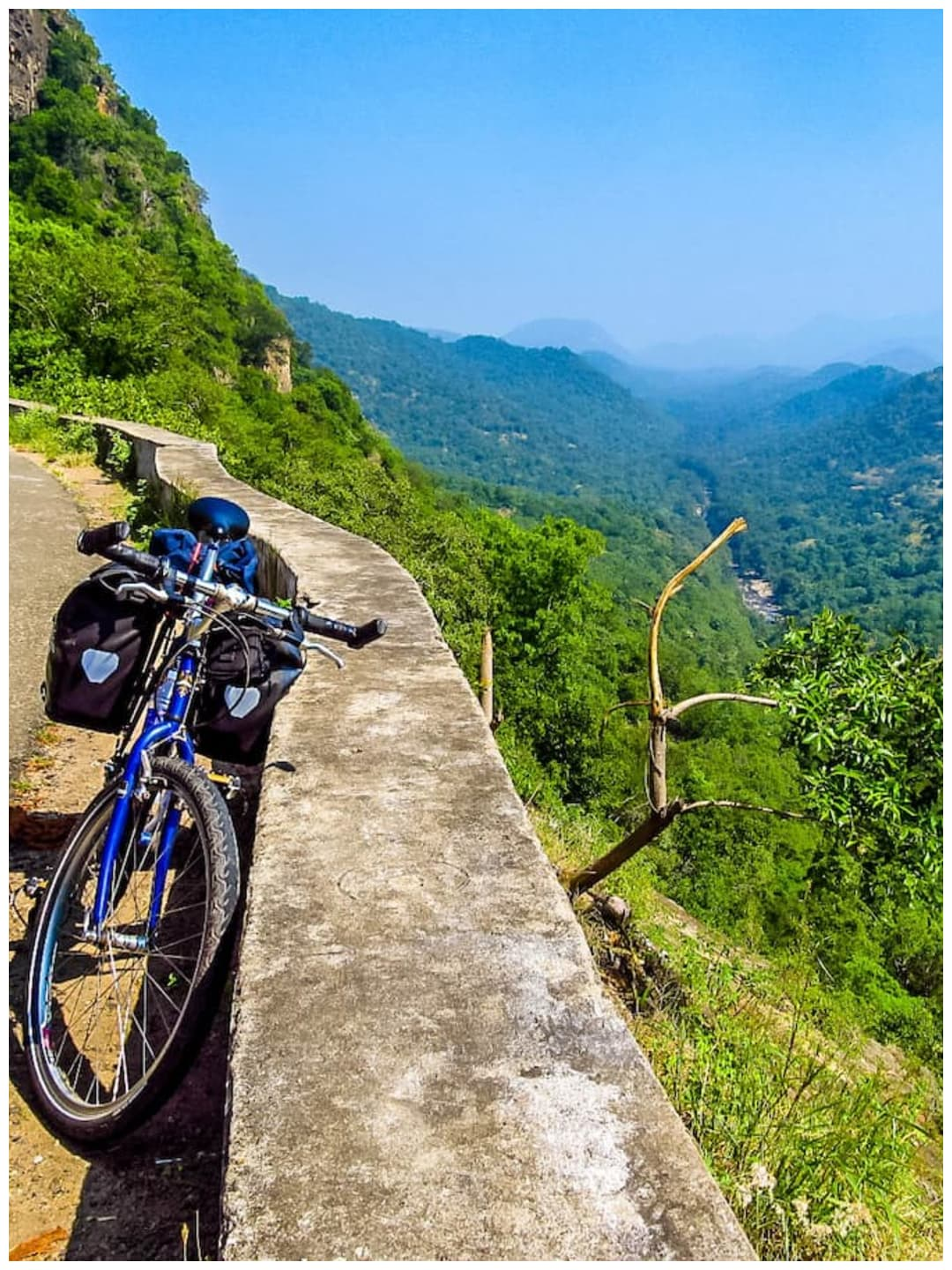
There are journeys in which the destination is the point, and others in which the fascination lies in watching one world gradually become another. Cycling from Mysore to Fort Kochi belongs firmly to the second kind. On a map, the journey appears straightforward enough: head south and west from Karnataka, cross a section of Tamil Nadu, climb over the Western Ghats, and descend through Kerala to the Arabian Sea. But a bicycle turns that simple line across a map into something much more revealing. You don’t simply leave one state and enter another. You feel the country changing beneath your wheels.
Leaving Mysore and the Deccan Behind
Mysore sits at about 750 meters above sea level, a gracious city of palaces, markets, broad avenues and enormous shade trees. It is an easy place to linger, and I did. But once I rode away from the city toward Kollegal and Hanur, Mysore disappeared remarkably quickly. The roads became quieter. Villages replaced city neighborhoods. The landscape grew drier and more open, and ahead rose the forested pilgrimage hills surrounding Male Mahadeshwara. MM Hills was not a place I had set out to see as a destination in itself. It was simply where the road took me. That is one of the pleasures of bicycle travel: places that would barely register on a conventional itinerary can become some of the strongest memories of a journey. Pilgrims shared the road. Buses climbed toward the temple. Small shrines appeared among the forest, and the busy urban world of Mysore suddenly seemed much farther away than the kilometers suggested. Then came the descent. Beyond MM Hills, I dropped out of Karnataka and into Tamil Nadu. There was no dramatic moment when one India ended and another began. Instead, the changes accumulated: a different script on roadside signs, different temple architecture, different rhythms in the towns, and an increasingly hot and arid landscape.
Across the Tamil Nadu Plains
For several days I rode across the plains through Mettur, Perundurai, Dharapuram and Udumalaipettai. These were not the most spectacular stages of the journey. There were no famous monuments demanding a stop and few places that would appear on anyone’s list of South India’s essential sights. But that was precisely what made the riding interesting. This was everyday Tamil Nadu: agricultural towns, roadside tea stalls, buses, bicycles, coconut processing, fields baking beneath the afternoon sun, dosa and idli for breakfast, strong filter coffee, temple towers rising above otherwise anonymous settlements.
And somewhere ahead, barely visible at first, were the Western Ghats. For days they remained a faint blue line on the western horizon. Then they began to grow. One of the things we lose when traveling quickly is an appreciation of scale. A train or car can take you from plains into mountains in a few hours. On a bicycle, the mountains announce themselves days beforehand. Each morning the Ghats were a little larger. By Dharapuram they had become unmistakable. Approaching Udumalaipettai, they seemed to occupy the entire western horizon—a great wall separating the dry interior from the tropical world of Kerala beyond. I knew I would have to cross them. That knowledge changes the way you look at mountains.
Climbing Into Another India
Beyond Udumalaipettai, the journey changed completely. The road entered the foothills and began climbing through the Anaimalai Tiger Reserve and Chinnar Wildlife Sanctuary toward Marayoor. The plains slowly dropped away behind me. The first transformation I noticed was not visual. It was temperature. After days riding through Tamil Nadu’s heat, cooler air began spilling down from the mountains. Vegetation thickened. Dry open country gave way to forest. The road twisted upward through increasingly dramatic valleys and beneath granite peaks.
Then came Kerala. Again, the political boundary mattered less than the physical transformation taking place around me. The landscape became greener. Churches appeared more frequently among the temples. Mountain streams crossed the valleys. Sandalwood forests surrounded Marayoor. And above Marayoor began one of the most beautiful stretches of cycling I have experienced anywhere in India. The tea country. At first the plantations appeared in patches. Soon entire mountainsides were covered with tea bushes arranged in immaculate flowing contours. The geometry was extraordinary. Tea-covered hills, valleys and ridges like a green fabric laid across the mountains. Narrow paths wandered between the bushes. Workers moved across the slopes gathering fresh leaves. Above everything rose bare granite summits, sometimes sharply defined against blue sky, sometimes disappearing completely into mist. The higher I climbed, the cooler it became. After the Tamil plains, it seemed almost impossible that this too was South India.
Munnar: High Above the Tropics
Munnar sits amid this extraordinary landscape of tea-covered mountains. The town itself has grown busy, but the country surrounding it remains the real attraction. Roads climb into high valleys through tea estates, eucalyptus groves and mountain settlements. Clouds can descend across the hills without warning, erasing a landscape that only minutes earlier seemed to extend forever. I rode from Munnar toward Top Station, close to 2,000 meters above sea level. There is something wonderfully improbable about needing an extra layer against the morning chill while riding in tropical India. But altitude had changed everything. That, again, is something a bicycle makes tangible. Elevation is no longer merely a number on a map or GPS screen. You have earned every meter of it. Your legs remember where the plains were. And then came the descent.
Two Thousand Meters Toward the Sea
Leaving Munnar for Kothamangalam, I began losing almost all the elevation I had worked so hard to gain. The transformation happened in reverse. Tea estates gradually disappeared. The air grew warmer. Tropical forest returned. Then came rubber, bananas and coconut palms. Humidity increased with every kilometer. By Kothamangalam I was almost back at sea level, and the cool misty mountains of Munnar already seemed like another country. Yet I was still in Kerala. That contrast is one reason this relatively short crossing of South India remains so vivid in my memory. Within days, I had ridden from dry Tamil plains into cool mountain tea country and back down into the heavy tropical air of the Malabar Coast.
Now water began to dominate the landscape. Rivers widened. Canals appeared. Lagoons and backwaters spread between settlements. Fishing boats replaced mountain buses as recurring elements of the scenery. Rather than riding directly into the traffic of Cochin, I approached Fort Kochi from the north via Vypin Island. It was a fitting final stage. I rode between Kerala’s backwaters and the Arabian Sea, through fishing villages and beneath coconut palms, past ferries and Chinese fishing nets. And eventually there was nowhere farther west to ride.
What a Bicycle Reveals
Looking back, what stays with me most is not any single sight along the route. It is the transition. If I had traveled from Mysore to Fort Kochi by plane, the two cities would have been separate experiences. Even by train or car, much of what lay between them would have passed too quickly to register. On a bicycle, nothing changed suddenly. The Western Ghats began as a blue smudge on the horizon and grew for days until they towered above me. I felt the temperature fall as I climbed. I watched dry vegetation become forest and forest become tea country. Then I felt the mountain coolness disappear again as I descended toward the coast. Languages changed. Religious architecture changed. Food changed. Agriculture changed. The quality of the air changed. Eventually even the smell of the landscape changed as the Arabian Sea drew closer.
This is what makes traveling by bicycle fundamentally different from simply visiting places. A bicycle occupies that peculiar middle ground between walking and mechanized travel. It moves quickly enough to cross regions and countries, yet slowly enough for geography to retain continuity. You understand that the dry Tamil plains and the misty tea gardens of Munnar are not separate destinations. One becomes the other. You understand why the Western Ghats matter because you have watched them approach and then climbed them. And reaching the sea means something because you remember exactly how far inland you began.
From the Deccan Plateau to the Arabian Sea
Fort Kochi made an appropriate ending. For centuries, people reached this coast from Arabia, China and Europe across the Indian Ocean, drawn by the spices of the Malabar Coast. Portuguese, Dutch and British influences remain layered into the old harbor quarter alongside Kerala’s much older Indian traditions. I arrived from the opposite direction—from the interior, on a bicycle. After the heat of Tamil Nadu, the climb into the Ghats, the mist around Munnar and the long descent toward the coast, sitting beside the harbor and watching ferries cross the water brought the journey quietly to an end. The distance from Mysore to Fort Kochi is not enormous. But distance is a poor measure of a journey. What matters is how much changes between beginning and end. And across this small corner of South India, almost everything did.
For cyclists interested in following this route, my Cycling Mysore to Fort Kochi: Over the Western Ghats to the Arabian Sea guide follows the journey stage by stage, with distances, elevation information, downloadable GPS tracks and 95 photographs. The paperback edition is also available from Amazon