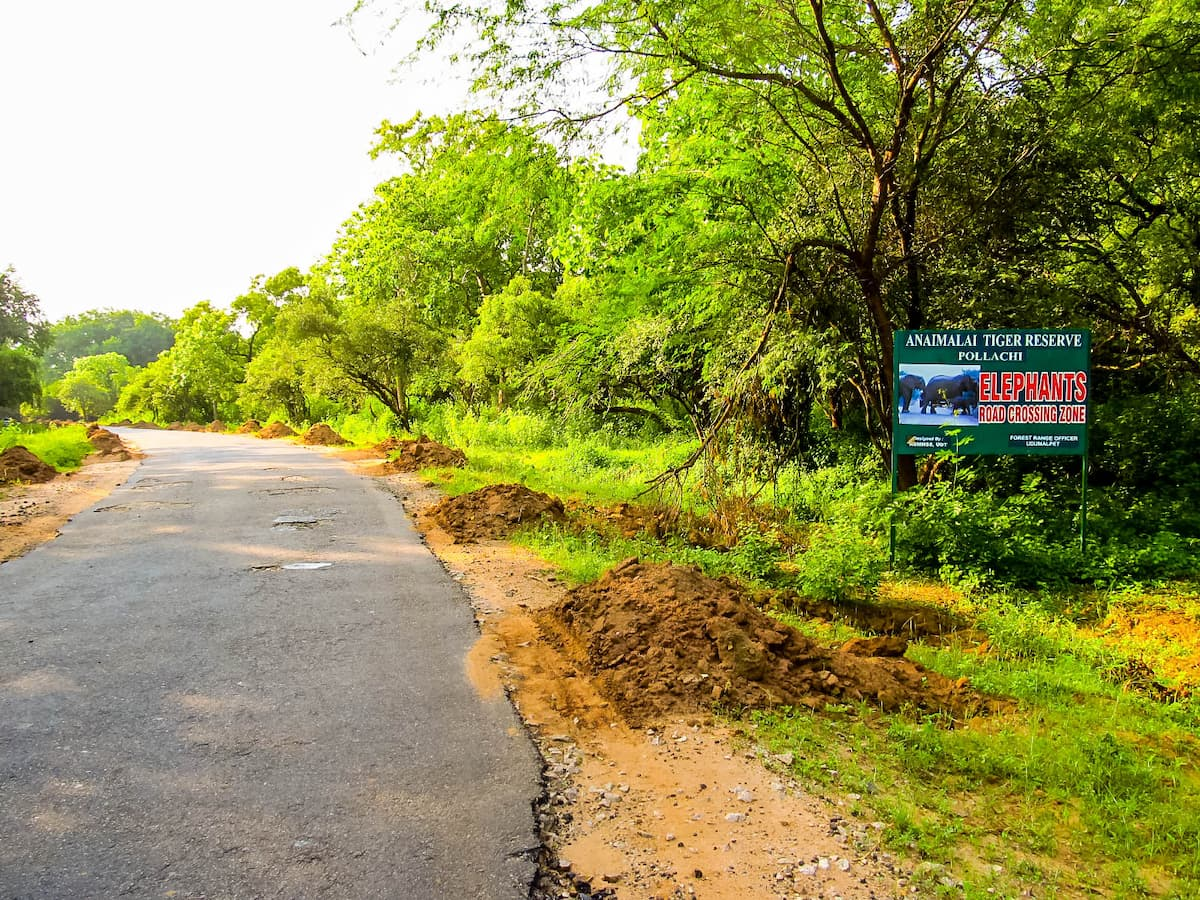
There is something wonderfully reassuring about a forest ranger telling you, “No problem. The elephants usually cross at night.” Usually.
I was cycling through the Anaimalai Tiger Reserve in southern India when I came upon this sign: ELEPHANTS ROAD CROSSING ZONE.
In a car, you might slow down, glance into the trees and hope to see one. On a bicycle, you read the sign again. Elephants. Road crossing. Zone.
And suddenly you become very interested in the precise meaning of the word usually.
I have had the same thought cycling through other wildlife country. Bears in Yellowstone. Asiatic lions around Gir National Park in Gujarat. Tiger country in India. The sensible people tell you the chances of an encounter are extremely small.
Which is comforting until you remember that statistics describe populations, not individual animals. Somewhere there is always one elephant that has not read the statistics.
So what exactly is the plan? A tiger appears behind you. Pedal faster? Excellent idea. A tiger can run around 50 or 60 km/h for a short distance. My chances of suddenly producing a Tour de France sprint are limited. A lion steps onto the road ahead. Turn around? Perhaps. But first I would need to persuade my hands to stop shaking long enough to operate the bicycle.
And an elephant? There is something particularly absurd about imagining yourself escaping an annoyed elephant on a bicycle. Do you sprint? Hide behind a tree? Abandon the bicycle as a peace offering? “Here, take the Shimano. We can discuss this.”
Of course, this is mostly the imagination at work. Millions of people travel through wildlife areas without incident, and local knowledge matters. Rangers understand the animals and their movements far better than a passing cyclist does.
But the vulnerability is real. A motorist watches wild country through glass and steel. Doors locked. Engine running. Accelerator available.
The cyclist has none of that. There is no barrier between you and the place you are traveling through. You hear the forest. You smell it. You notice movement in the undergrowth. And when the road becomes very quiet, your imagination suddenly develops remarkably good hearing.
Perhaps that is part of what makes traveling by bicycle so compelling. The bicycle removes the little fortress we normally carry around ourselves. Distance becomes real. Weather becomes real. Mountains become real.
And occasionally, so does the food chain. Most likely, nothing will happen. You will pedal through the forest, emerge safely on the other side, and later laugh at yourself for wondering whether every rustle in the bushes was a tiger preparing lunch.
But somewhere along that quiet road comes the unavoidable thought: What if this is the day when the one elephant that doesn’t usually cross during daylight decides—“I am coming.” And there you are. On a bicycle.
So, what would you do?