For centuries, the Balkans have been described as Europe’s troubled borderland: a region where empires met, religions confronted one another, and political boundaries repeatedly shifted. To many Western Europeans—and perhaps even more so to Americans—the Balkans can still seem vaguely distant, somewhere toward the continent’s southeastern edge. Greece is confidently claimed as the cradle of Europe, while the lands immediately north of it are often imagined as a corridor toward somewhere else: toward Byzantium, the Ottoman world, or the proverbial East.
But where does Central Europe end? Where do the Balkans begin? And if Athens represents the birthplace of European civilization, at what point on the road does one begin to feel that one is approaching it?
Cycling from Prague to Athens, I did not cross any single border where Europe abruptly changed character. The transition unfolded over thousands of kilometers: through church towers and minarets, Roman ruins and Ottoman mosques, battle-scarred cities and nationalist graffiti, mountain passes and sun-scorched coastal roads.
The journey began in Prague, in the familiar heart of Europe. It ended beneath the Acropolis, where a sign offered an emphatic answer of its own:
Europe Starts Here.
From Prague to the Ottoman Frontier
My route did not initially head directly south. I first rode northeast through the Eagle Mountains before turning through Polička and Rajhrad toward Slovakia. After Gajary, I briefly crossed Austria near Frauenkirchen and continued into Hungary through Sárvár and toward Keszthely, on the shore of Lake Balaton.
Up to that point, the cultural landscape remained recognizably Central European. The languages changed, as did the architecture and national histories, but the towns and countryside still belonged largely to the former Habsburg world.
Beyond Balaton, however, the Ottoman presence began to emerge from beneath that Central European surface.
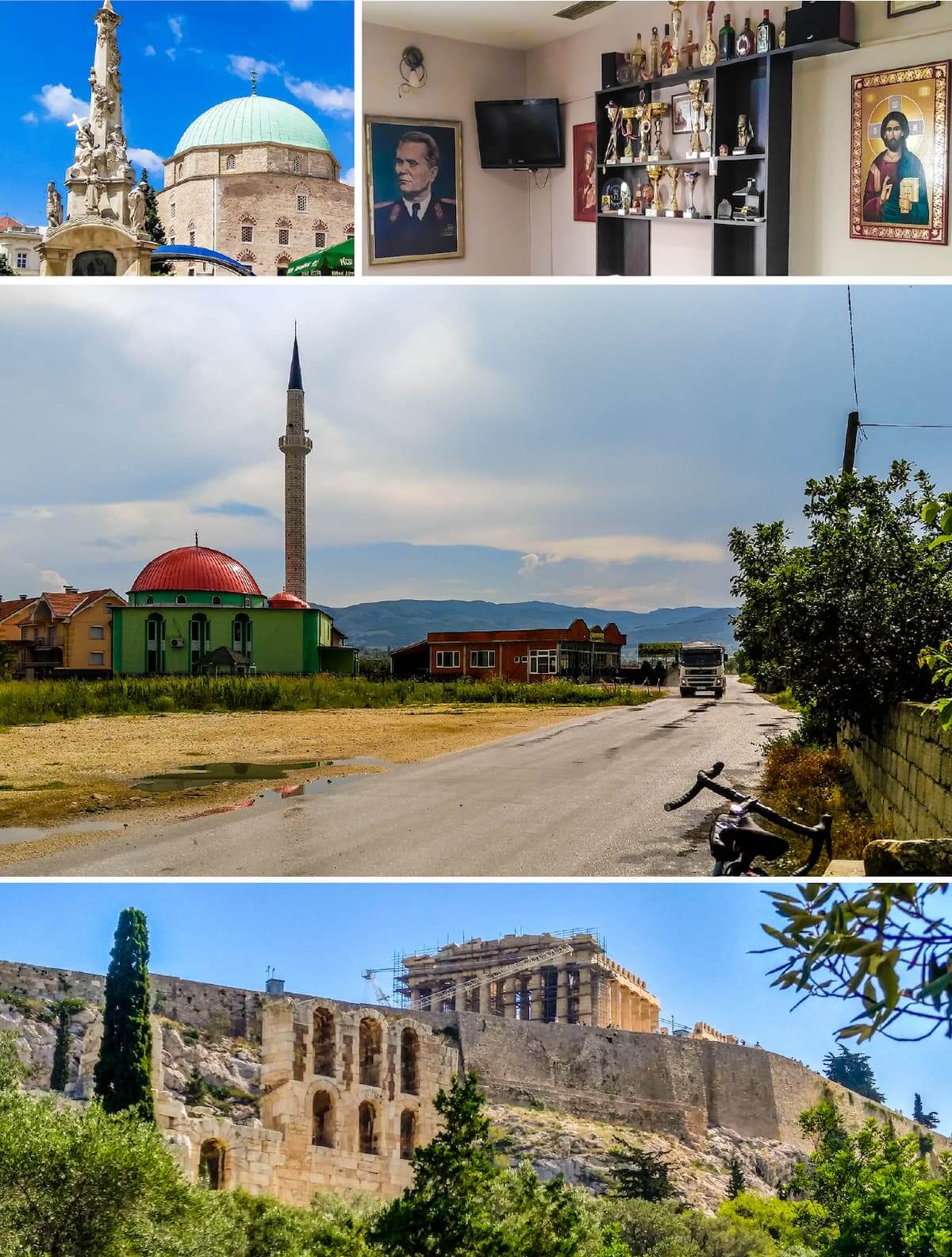
Pécs offered the first powerful example. It is one of Hungary’s largest and most historically layered cities, with a cathedral, a UNESCO-listed early Christian necropolis, and architecture ranging from Gothic to Art Nouveau. Yet the building dominating its central square is the former Mosque of Pasha Qasim the Victorious.
Pécs remained under Ottoman rule for nearly a century and a half. After the Habsburg reconquest in 1686, the mosque was converted into a Catholic church; its minaret was eventually demolished in the eighteenth century. Today, the building embodies both histories. A cross rises above its Ottoman dome, while Islamic architectural elements remain visible within what is now the Downtown Candlemas Church of the Blessed Virgin Mary. Rather than erasing one age in favor of another, it reveals how one civilization was built—sometimes literally—upon the remains of its predecessor. Treasures of Hungary
From Pécs and nearby Harkány, I continued toward Croatia. The route was no longer merely approaching the Balkans as a geographical region. It was entering lands in which the Ottoman legacy, the breakup of Yugoslavia, and the unresolved tensions of recent history remained unmistakably present.
Cities Rebuilt, Memories Unresolved
Osijek appeared peaceful and attractive when I arrived, its avenues and grand façades offering little immediate suggestion of what the city had endured.
During the Croatian War of Independence, Osijek was subjected to sustained artillery attacks by the Yugoslav People’s Army and Serbian paramilitary forces. Hundreds were killed, much of the population fled, and buildings throughout the city were damaged. By the time I cycled through in 2017, most of the destruction had been repaired. A visitor might still notice bullet marks on a few façades, but the physical evidence could no longer convey the fear and disruption experienced by those who had lived there.
Vukovar was different.
The name itself had become inseparable from the war. In 1991, the city endured an 87-day siege by the Yugoslav People’s Army and associated Serb forces. It was shelled until much of it lay in ruins. After Vukovar fell, prisoners and civilians taken from the city hospital were transported to Ovčara, where more than two hundred were killed. The United Nations tribunal’s historical record describes Vukovar’s capture in November 1991 as the end of a devastating three-month siege during which hundreds of residents died and much of the city was destroyed. United Nations—Vukovar Crimes
The reconstructed city I entered by bicycle could never be the same city that had existed before the siege. Buildings can be rebuilt. Streets can be repaved. Trees grow again. But reconstruction does not return the dead, erase displacement, or restore trust between communities.
For Croatians, Vukovar became a national symbol of resistance—a “Croatian Stalingrad.” Yet continuing from Vukovar into Serbia meant entering another national memory, another historical narrative, and another understanding of grievance and victimhood.
That is one of the unsettling lessons of traveling through the Balkans. History changes as one crosses a border. The event commemorated as liberation in one country may be remembered as catastrophe in the next. Each community has its monuments, its martyrs, and its carefully preserved wounds.
Belgrade and the Weight of Serbia’s Past
After crossing into Serbia, I reached Novi Sad and the great fortress of Petrovaradin before continuing along the Danube toward Belgrade.
The Church of Saint Sava dominates the Serbian capital’s skyline. It stands on the Vračar plateau, traditionally associated with the place where Ottoman Grand Vizier Sinan Pasha ordered the burning of Saint Sava’s relics in 1595. The act was intended to crush a powerful symbol of Serbian Orthodox identity. Instead, it entered the nation’s collective memory as an enduring grievance and transformed Saint Sava into an even more potent emblem of spiritual and national survival.
The immense church that now stands there is therefore more than a religious building. Its monumental dome declares the continuing presence of Serbian Orthodoxy after centuries of Ottoman rule and decades of communist Yugoslavia.
Yet the Serbia I encountered was not speaking only through churches.
Written in Cyrillic on walls and sidewalks were slogans proclaiming:
Kosovo is Serbia.
Elsewhere I saw Serbia Yes, NATO No and Yankee Go Home. Near the grand Hotel Moskva, another inscription declared Serbia part of the “Russian bloc.” The messages were still visible in 2017, nearly two decades after NATO’s 1999 bombing campaign and nine years after Kosovo declared independence.
Two hotel façades seemed to offer an accidental metaphor. One was the rundown Hotel Balkan, its very name appearing neglected. The other was the polished and immaculately maintained Hotel Moskva—Hotel Moscow. It would be too convenient to interpret architecture as political doctrine, yet the contrast was striking in a city where affinity with Russia and resentment toward NATO were openly displayed.
Farther south, at a restaurant in Aleksinac, two icons hung side by side: Josip Broz Tito and Jesus Christ.
It was a wonderfully Balkan arrangement. One represented the secular socialist state that had attempted to hold Yugoslavia together; the other, a faith that long predated it and survived it. Their coexistence on one restaurant wall suggested that history here rarely proceeds by replacing one identity neatly with another. Instead, allegiances accumulate, contradict one another, and somehow continue living side by side.
The Gateway to the East
From Belgrade, my route led through Lapovo and Aleksinac to Niš.
Conquered by Rome in the first century BC, ruled for periods by Byzantium, and taken by the Ottoman Empire in the fifteenth century, Niš is one of the oldest cities in the Balkans. It has often been called one of the gateways between East and West.
Cycling around the Niš Fortress, I stopped at the Bali-Beg Mosque. Riding into the city center, I sensed another transition beginning. Yet Niš and nearby Leskovac still looked and felt predominantly like central Serbia. Serbian Orthodox churches remained the principal religious landmarks, and the cultural change was still subtle.
South of Vranje, it became much more apparent.
Minarets began to rise above villages. In places, mosques replaced Orthodox churches as the dominant feature of the skyline. To the west, a mountain ridge separated the road from Kosovo. Around Bujanovac and Preševo, ethnic Albanians formed the majority population, particularly in the Preševo Valley.
The map still said Serbia, but the human landscape no longer conformed to a simple national label. Serbian, Albanian, Orthodox, Muslim, Slavic, Ottoman, and Yugoslav histories converged within a narrow geographical corridor.
The gradual nature of the transition was precisely what made it revealing. From a train or airplane, one moves abruptly between major cities. On a bicycle, every village participates in the change. A church disappears behind you; a minaret appears ahead. The writing on shopfronts changes. Roadside cafés, clothing, houses, cemeteries, and cultivated fields announce that another cultural world is approaching long before the political border confirms it.
A Country Searching for Its Past
The border of what was then officially called the Republic of Macedonia lay less than ten kilometers beyond Preševo.
In 2017, the country’s very name was still part of an unresolved dispute with Greece. Soon after crossing the frontier, I encountered a billboard for Alexander the Great Airport in Skopje. The message seemed deliberate. The young Slavic-majority republic had adopted figures and symbols associated with ancient Macedon as part of its modern national identity, even as Greece regarded that heritage as fundamentally Hellenic.
The dispute lasted 27 years. Under the Prespa Agreement, signed in June 2018 and brought into force in February 2019, the country became the Republic of North Macedonia. The agreement did more than add a geographical qualifier: it recognized that Greece and North Macedonia understood the terms “Macedonia” and “Macedonian” within different historical and cultural contexts. It affirmed the modern Macedonian language as South Slavic while distinguishing North Macedonia’s history and identity from the ancient Hellenic civilization associated with the Greek region of Macedonia. Official Prespa Agreement
I had ridden through before that settlement.
From Crnilište and Sveti Nikole, I continued toward Radoviš and Strumica. In Strumica stood a monument to Goce Delčev, the revolutionary who fought Ottoman rule and is now claimed within competing Macedonian and Bulgarian historical narratives. Erected in 1975 during communist Yugoslavia, the monument had acquired new relevance in the post-Yugoslav nation, where historical figures became vital instruments in constructing a distinct national story.
Near Valandovo, the road presented a tantalizing geographical choice. I could continue toward Lake Dojran and Greece, or turn eastward across Thrace toward Istanbul, Turkey, and Asia.
I continued south.
Entering Greece
At Lake Dojran, the border opened into the Greek region of Macedonia. Roadside shrines began appearing in remarkable variety: some miniature replicas of Orthodox churches, others resembling tiny chapels containing an icon, a candle, or a small offering. Some commemorated lives lost on the road. Others expressed gratitude or invoked the protection of a saint.
The first major destination was Thessaloniki, where the historical layers I had been following since Hungary seemed to converge within a single city.
The White Tower recalled the Ottoman port fortress and the building’s later use as a prison. The Arch of Galerius carried sculpted reliefs commemorating a Roman victory over the Persians. Nearby stood the immense fourth-century Rotunda, originally constructed within the Roman imperial complex and later serving successively as a Christian church and an Ottoman mosque.
Roman, Byzantine, Ottoman, Jewish, Greek—the identities of Thessaloniki could not be reduced to any one civilization.
Yet beyond the city, history slowly gave way to the physical pleasure of cycling beside the Aegean Sea.
From Agiannis and Makrygialos, I followed the eastern coast south through Stomio and Agiokampos. Near Kokkino Nero, the morning views along the coastal road were magnificent. The sea caught the early light while the mountains rose sharply inland. Farther south, the route passed Kato Amigdali and Kalamaki, with views toward the Mount Pelion range before descending into Volos.
This was my favorite stage of the Greek coastal traverse.
Volos felt more compact and immediately likeable than Thessaloniki. It also stood at the threshold of another maritime world. From there, I crossed to Evia, Greece’s second-largest island after Crete, yet one of the least internationally known.
Through the Waters of Ancient History
Evia stretches for more than 170 kilometers, separated from the mainland by channels that at times resemble narrow rivers rather than open sea. My route followed the island south through Agiokampos, Paralia Agias Annas, Eretria, and Nea Styra.
One morning, while waiting for the first café to open at Artemisio, east of Pefki, I lingered beside the Strait of Artemisium.
The shore was quiet, but the place carried one of the great stories of the ancient world. In 480 BC, Greek naval forces fought the Persian fleet in these waters while, across the channel on the mainland, Leonidas and his force defended the pass at Thermopylae.
Standing beside the strait, it was possible to see how geography shaped history. These were not abstract names from schoolbooks. The narrow waters, mountain corridors, and coastal passages determined where fleets could maneuver and armies could advance. Traveling slowly through them returned physical scale to events that history tends to compress into a few dramatic sentences.
From southern Evia, I crossed back toward Attica. Athens was now only one day away.
But Greece was in the grip of record heat. For three relentless days, the only practical way to ride was to begin before six in the morning and finish no later than eleven. The final approach passed through a cypress-lined road near Kato Souli, toward Marathon and the coastal route into Athens.
The journey that had begun in Prague now approached its conclusion through another landscape weighted with names familiar to nearly everyone: Marathon, Attica, Athens, the Agora, the Acropolis.
Europe Starts Here
At Monastiraki, I reached the entrance to the Ancient Agora and looked upward toward the Acropolis.
The route behind me had passed through Czechia, Slovakia, Austria, Hungary, Croatia, Serbia, North Macedonia, and Greece. It had crossed the former territories of the Habsburg and Ottoman empires and traced part of the fault line along which Catholic, Orthodox, and Muslim worlds had met. I had ridden through cities reconstructed after war, past nationalist graffiti, Ottoman mosques converted into churches, Orthodox monuments built over memories of persecution, and communist-era statues repurposed in the service of new national identities.
Throughout the journey, history had been used to explain belonging: who belonged to a land, who had arrived later, who had suffered, and who had prevailed. The closer I came to Athens, the farther backward those historical claims seemed to reach.
At the Acropolis, a sign declared:
The Acropolis and its surrounding archaeological sites—the heart of Ancient Athens—are the place where the most essential aspects of European identity emerged: democracy, philosophy, theater, sciences, and the arts.
It ended with three words:
Europe Starts Here.
After cycling from Prague, it was impossible not to feel the power of that statement. Yet the road behind me also complicated it.
Europe may have found some of its most influential ideas in ancient Athens, but the Europe I had crossed was made from far more than one point of origin. It was Roman and Byzantine, Catholic and Orthodox, Ottoman and Habsburg, Jewish, Muslim, Slavic, Germanic, Magyar, Greek, and Albanian. It was formed not only by philosophy and democracy but by conquest, migration, faith, nationalism, communism, resistance, and the redrawing of borders.
Perhaps Europe does start in Athens.
But cycling there from Prague taught me that Europe must also be searched for along the entire road—in the mosque beneath the church dome in Pécs, in the reconstructed streets of Vukovar, in the graffiti of Belgrade, in the minarets south of Vranje, in the contested name of Macedonia, in the ancient waters off Evia, and in every village where one history slowly gives way to another.
Athens was the perfect place to end the journey.
It was not, however, the only place where Europe began.
** My Prague to Athens book is available in PDF and in paperback at Amazon.
For related subjects, see Cycling Prague to Odessa, Ukraine essay.