There are places we travel to see, and places that reveal themselves because of the way we travel through them.
Rajasthan belongs to both. Its great attractions need little introduction: Udaipur’s palaces reflected in Lake Pichola, the mountain fortress of Kumbhalgarh, the marble temples of Ranakpur, the immense plateau of Chittorgarh, Bundi’s painted palaces and blue lanes, the wilderness surrounding Ranthambore. They are reasons enough to travel across Rajasthan. But traveling between them by bicycle taught me something else.
The Rajasthan I remember most vividly was often the Rajasthan I had not come to see.
It was simply there along the road.
A Thousand Kilometers at the Speed of a Bicycle
My journey began in Udaipur and ended more than a thousand kilometers later in Karauli, crossing southern and eastern Rajasthan through the Aravalli Hills before continuing toward Chittorgarh, Bundi, Ranthambore and the smaller towns and villages beyond. There was a route, certainly. There was a destination each day. But increasingly, the destinations became only the framework. The bicycle changed the scale of everything between them. A car makes the countryside between Udaipur and Kumbhalgarh something to cross. On a bicycle, every kilometer becomes somewhere.
You notice a shepherd coming toward you with his goats. Women carrying water. Children cycling to school. A camel cart moving at roughly your own speed. Mustard flowering beside the road. A temple that would scarcely register through a car window. You hear a village before you reach its center. You smell wood smoke and cooking fires. Someone waves. You stop for chai. And suddenly twenty minutes have disappeared. Nothing important has happened. Except that perhaps it has.

The Day the Bicycle Turned Upside Down
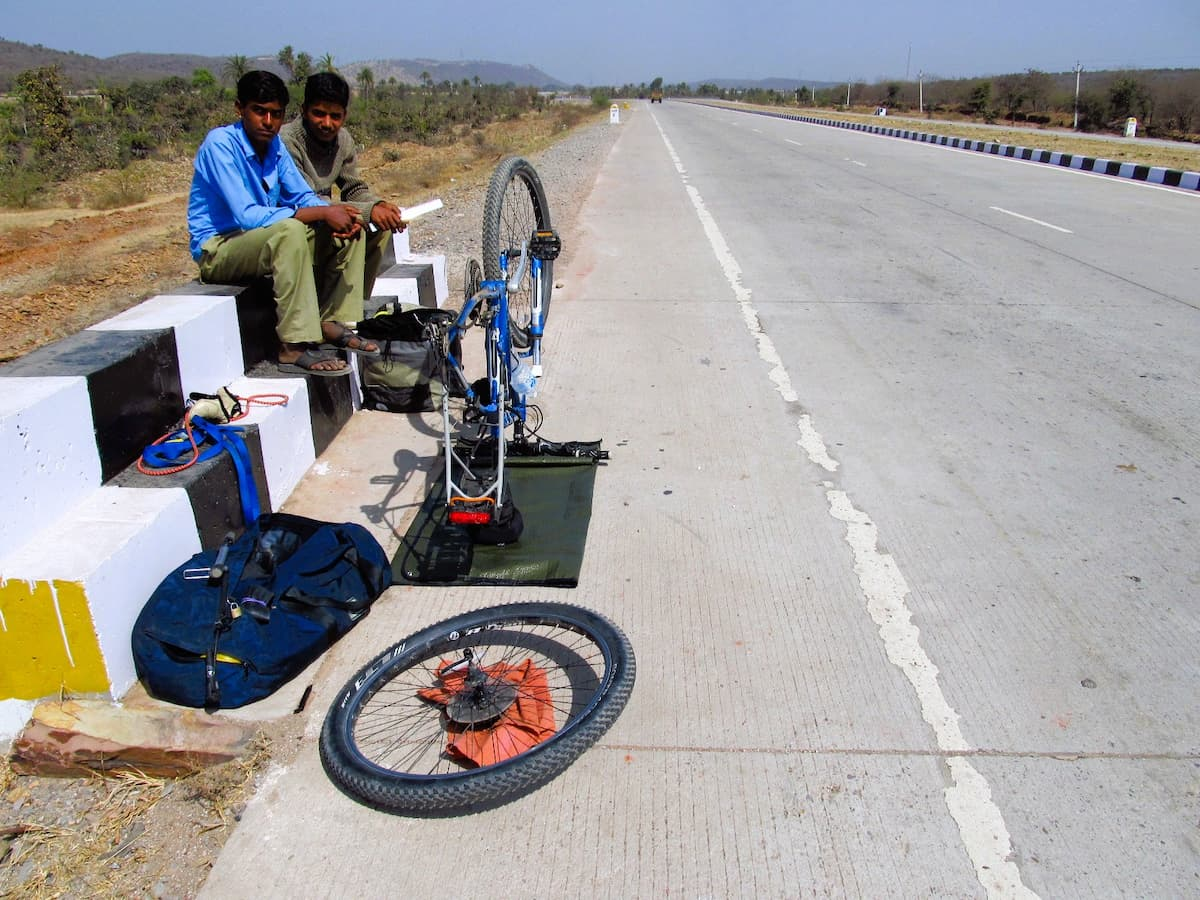
One photograph from the journey captures this better than any picture I have of Rajasthan’s great monuments. My bicycle is upside down beside an almost empty road. The wheels are off, the panniers are scattered around me, and I am repairing another puncture. At first, two students appeared. They sat down beside me and watched. Then others arrived. Goat and cattle herders stopped. More people gathered. By the time the bicycle was back together and loaded, what had begun as a solitary puncture repair had become an impromptu roadside gathering.
I hadn’t stopped there to meet anyone. I had stopped because I had a flat tire. Yet the mechanical nuisance became a social event. That happened repeatedly in Rajasthan. Something goes wrong with a bicycle and you become stationary. Once stationary, you cease being merely a traveler passing through. People approach. Someone wants to know what you are doing. Someone examines the bicycle. Someone offers help. Someone else simply watches. Conversation begins even when there is little shared language.
The distinction between observer and participant begins to disappear.
I had ten punctures during the journey. I remember cursing the thorns. Looking back, I also remember the people who appeared because of them.
The Roads Between the Rajasthan We Know
The famous Rajasthan is monumental. Fortresses crown mountains. Palaces dominate old cities. Temple towers rise above villages. History announces itself everywhere. The Rajasthan between those places is quieter. Some of my favorite roads were barely more than a strip of tarmac winding through the Aravalli Hills. Traffic might consist of an occasional motorcycle, tractor, herd of goats or group of children on bicycles.
Elsewhere even the tarmac disappeared. One afternoon, while trying to avoid the main highway to Chittorgarh, I followed progressively smaller roads until the road itself seemed to cease to exist. My GPS knew where Chittorgarh was. It was considerably less helpful in explaining how I was supposed to get there. Eventually a woman appeared carrying a bundle of branches on her head. I showed her where I wanted to go. She pointed toward one of several tracks disappearing into the thorn scrub. That became my road. Darkness eventually caught me before Chittorgarh did, and I pitched my tent among the thorn bushes.
The next morning both tires were flat. Rajasthan had made its point.
Where a GPS Track Meets a River
Days later, beyond Ranthambore, another road simply ended at the Banas River. There was no bridge. Buffalo were crossing, so evidently I could too. I began preparing to unload the bicycle and carry everything across separately. Before I could do so, a man picked up my panniers and started walking through the water. A buffalo herder then lifted my loaded bicycle onto his shoulders and followed him. I was left carrying my shoes. On the other bank, they put everything down and continued on their way. No transaction. No arrangement. Two strangers had seen somebody who needed help and helped him.
The crossing itself turned out to be far from finished. More channels followed, then kilometers of deep sand churned by tractors hauling material from the riverbed. It was difficult, dusty and exhausting. It was also one of the days I remember best. That is the paradox of bicycle travel. The days when everything works perfectly are not necessarily the days that stay with you.
Forts, Palaces and Temples
None of this diminishes Rajasthan’s celebrated places. Quite the opposite. Arriving at Kumbhalgarh after cycling through the Aravallis gives the fortress a geographical meaning that arriving by vehicle cannot quite reproduce. You understand why it was built there because your legs have already explained the hills to you. At Ranakpur, the transition from dry countryside to an almost impossible abundance of carved marble becomes more dramatic. Chittorgarh isn’t simply a fortress reached from a parking lot. It is a great plateau that appears on the horizon after a morning of village roads and fields. Bundi emerges beneath its palace after days of moving eastward. And Karauli becomes more than another historic town because it is where the road finally ends. Cycling doesn’t replace the monuments. It connects them.
And Sometimes a Palace at the End of the Road
My own journey contained an unusual contradiction. I was traveling independently by bicycle, sometimes camping and sometimes staying in very simple accommodation. Yet at other times I found myself sleeping in former Rajput palaces and forts. There was a reason. At the time I was working as a tour operator, and my Indian partners and the owners of several heritage properties wanted me to experience places to which I might later send clients. Those clients would normally arrive in air-conditioned four-wheel-drive vehicles. I arrived dusty, carrying panniers. The contrast amused me then and still does.
But it also added another dimension to the journey. A bicycle tour need not be an exercise in deprivation. Rajasthan offers the unusual possibility of spending a day on tiny rural roads and ending it inside a centuries-old aristocratic residence. For some cyclists, that combination may be part of the attraction.
Rajasthan Does Not Need to Be Searched For
When I recently revisited the photographs from this journey, I was struck by their number. Not simply photographs of forts and temples, but faces. Shepherds. Pilgrims. Farmers. Children. Market vendors. Women carrying water or firewood. Men sitting beneath banyan trees. People at railway stations. People who stopped because I stopped. I hadn’t gone searching for these photographs.
Rajasthan’s daily life unfolded along my way, no matter what my destination was that day.
That may be the strongest argument I can make for cycling there. For cyclists interested in following the journey, the complete Udaipur-to-Karauli route is available as a downloadable PDF edition of Cycling Rajasthan: Forts, Palaces, Temples and Thorns, including the GPS tracks. A paperback edition, with more than 270 photographs from the journey, is also available on Amazon.
India resists introduction. It is too large, too layered and too contradictory to be reduced to a neat beginning. Rajasthan is one immense and distinctive part of it—a world of forts and palaces, temples and pilgrimage, brilliant color and austere landscapes, where history remains inseparable from everyday life. And perhaps nowhere is that Rajasthan more revealing than on the roads between its celebrated destinations. Travel slowly enough and you don’t have to search for the story. It is already happening around you.
All you have to do is watch.