When people dream of visiting Japan, they usually think of Tokyo, Kyoto, or perhaps Mount Fuji. Fewer travelers venture farther south to Kyushu, Japan’s third largest island and perhaps its most surprising.
Kyushu is called the Land of Fire, and deservedly so. Volcanoes created the island and continue to shape it today. The same subterranean forces that occasionally remind the Japanese of their destructive power through earthquakes and eruptions have also bestowed upon Kyushu one of its greatest gifts – its extraordinary abundance of hot springs.
It is impossible to understand Kyushu without understanding the fire beneath it.
Japan possesses more than one hundred active volcanoes – approximately ten percent of the world’s active volcanoes – and many of its most famous volcanic landscapes are found on Kyushu. Mount Aso, one of the world’s largest volcanic calderas, dominates the center of the island, while Sakurajima near Kagoshima remains one of Japan’s most active volcanoes. Mount Unzen, whose devastating eruptions have shaped both the landscape and the history of the region, rises dramatically above the Shimabara Peninsula. The volcanic groups of Kirishima and Kuju add still more evidence that Kyushu is very much a living geological landscape.
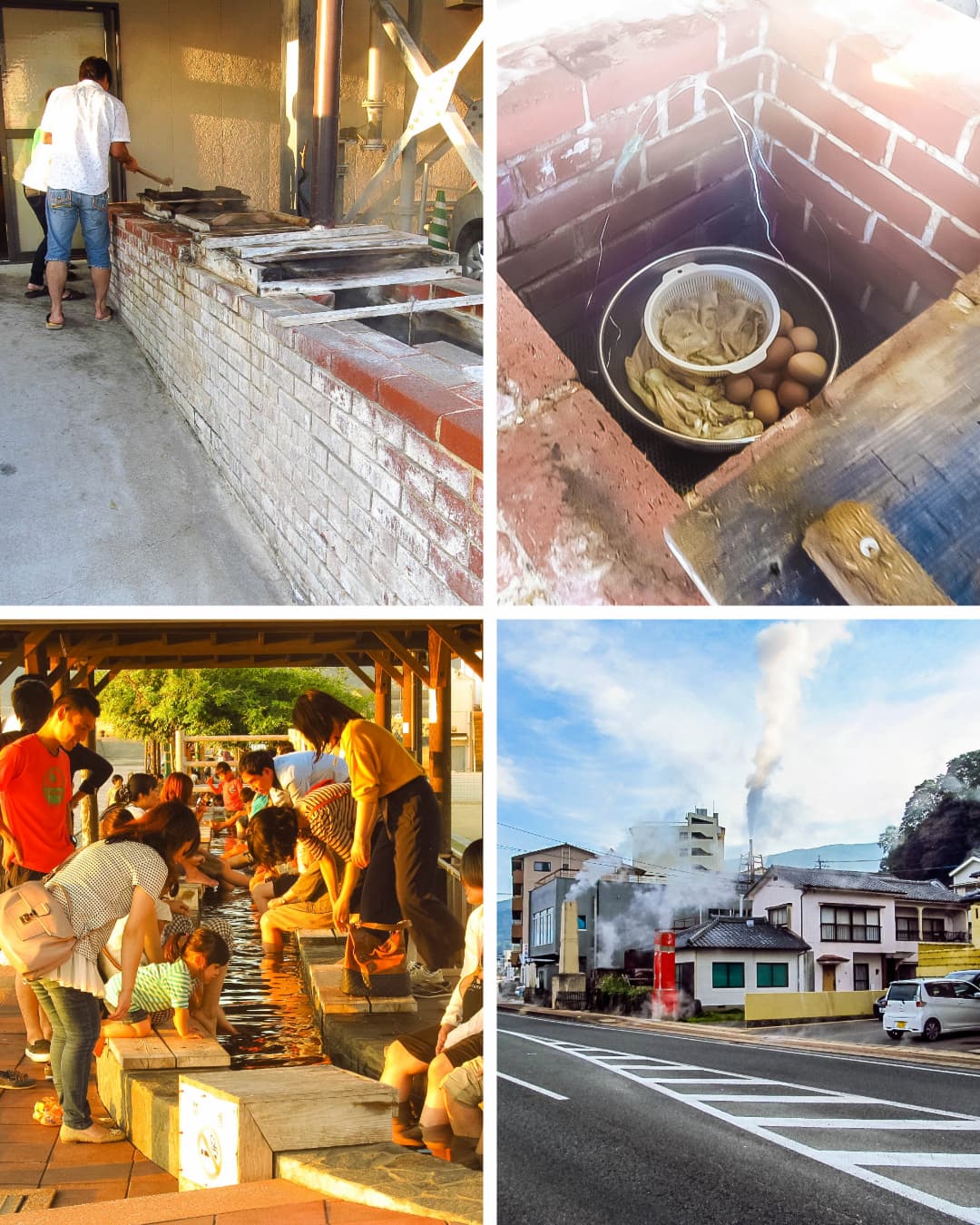
These volcanic forces have produced another phenomenon for which Kyushu is equally famous – hot springs. Kyushu leads Japan in both the number of hot spring sources and the volume of water flowing from them. Entire towns owe their existence to geothermal activity. In places such as Beppu, steam rises from streets and rooftops while restaurants cook food using geothermal heat drawn directly from beneath the earth.
The Japanese word onsen simply means hot spring, but to describe an onsen merely as a bath would be to misunderstand its place in Japanese culture. Onsens are where people relax, socialize, and retreat from the world. Visitors staying at traditional inns often spend hours moving between indoor and outdoor baths before enjoying an elaborate evening meal. Entire communities have been built around the ritual of soaking in mineral-rich waters for centuries.
Kyushu may well be Japan’s greatest onsen destination.
Yet volcanoes and hot springs are only part of its story.
Historically, Kyushu has long been Japan’s gateway to the outside world. It lies closer to the Asian continent than any other of Japan’s main islands, and for centuries it served as Japan’s principal point of contact with Korea, China, and later Europe.
Portuguese ships first arrived here in the sixteenth century, bringing Christianity, firearms, and entirely new ideas to Japan. Dutch traders followed, and when Japan closed itself to much of the outside world during the Tokugawa period, Nagasaki became the country’s only official window onto the West. The tiny artificial island of Dejima allowed carefully controlled trade with the Dutch for more than two centuries, while much of the rest of Japan remained closed to foreign influence.
The cultural legacy of those centuries remains visible today.
In Hirado, one finds churches standing alongside Buddhist temples and Shinto shrines. In Nagasaki, Chinese influences intermingle with Japanese traditions and reminders of European contact. Elsewhere, hidden Christian communities quietly preserved their faith for generations despite severe persecution during the Tokugawa era. Today, several of these sites form part of UNESCO’s World Heritage designation commemorating the Hidden Christians of the Nagasaki region.
Traveling through Kyushu often feels like traveling through several different Japans.
Northern Kyushu offers bustling cities such as Fukuoka and historic ports like Karatsu and Hirado. The western coastline reveals secluded fishing villages and dramatic island scenery. Southern Kyushu is dominated by volcanoes, fertile agricultural valleys, and rugged coastlines where wild horses still graze above the sea at Cape Toi.
The center of the island belongs to Mount Aso.
The Aso Caldera is among the largest in the world, measuring approximately 25 kilometers north to south and 18 kilometers east to west. Entire towns lie within its immense volcanic basin. Roads climb its rim before descending into a landscape of rolling grasslands, volcanic cones, and fertile farmland. Few places better illustrate the relationship between destruction and creation that characterizes so much of Kyushu’s geological history.
Perhaps what surprises first-time visitors most is the diversity compressed into a relatively small island.
One morning you might find yourself watching fishermen unload their catch at a small harbor. By afternoon you could be soaking in a mountainside hot spring overlooking a volcanic valley. The following day may bring a walk through centuries-old temple grounds or a ferry ride between offshore islands.
And then there is the food.
Kyushu is renowned for its ramen varieties, fresh seafood, black pork from Kagoshima, wagyu beef, sweet potatoes, volcanic spring water, and countless regional specialties. The culinary traditions of Nagasaki alone reflect centuries of Chinese, Portuguese, and Dutch influences that distinguish it from much of the rest of Japan.
For all its attractions, however, what I remember most about Kyushu is something more difficult to describe.
There is a certain gentleness to the island.
Despite its volcanoes and dramatic landscapes, life seems to unfold at a slower pace than in Japan’s great metropolitan centers. Traditional fishing villages remain very much alive. Rural roads meander through rice fields and forests. Small public baths continue welcoming locals every evening. Even in its cities, Kyushu somehow feels less hurried.
Perhaps it is because the people of Kyushu have lived for centuries beneath the constant reminder that the earth itself is never entirely still. Volcanoes erupt, earthquakes come and go, and the steam rising quietly from countless hot springs serves as a perpetual reminder of the immense forces hidden beneath the island.
The Land of Fire has become equally the Island of Hot Springs.
For travelers visiting Japan for the first time, Kyushu may not be the most obvious destination. Yet for those willing to venture beyond Tokyo and Kyoto, it offers something increasingly difficult to find in our hurried world – extraordinary natural beauty, remarkable history, living traditions, and enough quiet moments to remind us why we travel in the first place.
If Kyushu inspires you to explore Japan beyond its most familiar destinations, you may also enjoy my articles and cycling guides exploring Hokkaido and the historic old roads of Japan, as well as my journey around Kyushu itself.
If you are considering exploring Kyushu by bicycle, you can also find practical route information, GPS tracks, and 17 stages in my Cycling Kyushu: Around Japan’s Land of Fire guide.