There are faster ways to travel between Goa and Hampi.
Most visitors fly, take a train, or pass through the interior without ever truly seeing it. The journey becomes a transfer—efficient, forgettable.
But between the Arabian Sea and the stone temples of Hampi lies a quieter India.
A landscape that unfolds gradually:
coastal villages and fishing boats,
coconut groves and ferry crossings,
the long, humid climb into the forests of the Western Ghats,
and beyond them, the wide-open expanse of the Deccan Plateau.
This is a journey best experienced slowly—by bicycle.
A route shaped by landscape and time
Cycling Goa to Hampi is not simply a connection between two destinations. It is a transition through distinct worlds.
The ride begins along the Konkan coast, where the rhythm of daily life is tied to the sea. Roads wind through villages where little has changed, where the pace is unhurried, and where the presence of an outsider still feels momentary.
Then comes the climb.
The Western Ghats rise abruptly from the coast, dense with jungle and humidity. The ascent is steady, at times demanding, but it marks a turning point—not only in elevation, but in atmosphere. As you crest the range, the air dries, the forests thin, and the road opens into the vast plateau beyond.
From here, the riding changes. The terrain softens into long, rolling distances. The horizon stretches. The sense of space becomes immense.
And gradually, another layer begins to emerge—history.
In the footsteps of the Chalukyas and Vijayanagara
This route passes through one of India’s most remarkable yet often overlooked architectural landscapes.
Near Badami, Pattadakal, and Aihole, the early Chalukya temples stand scattered across the countryside—quiet, weathered, and deeply expressive. These are not monumental sites crowded with visitors, but places where you can linger, observe, and begin to understand the evolution of temple architecture in India.
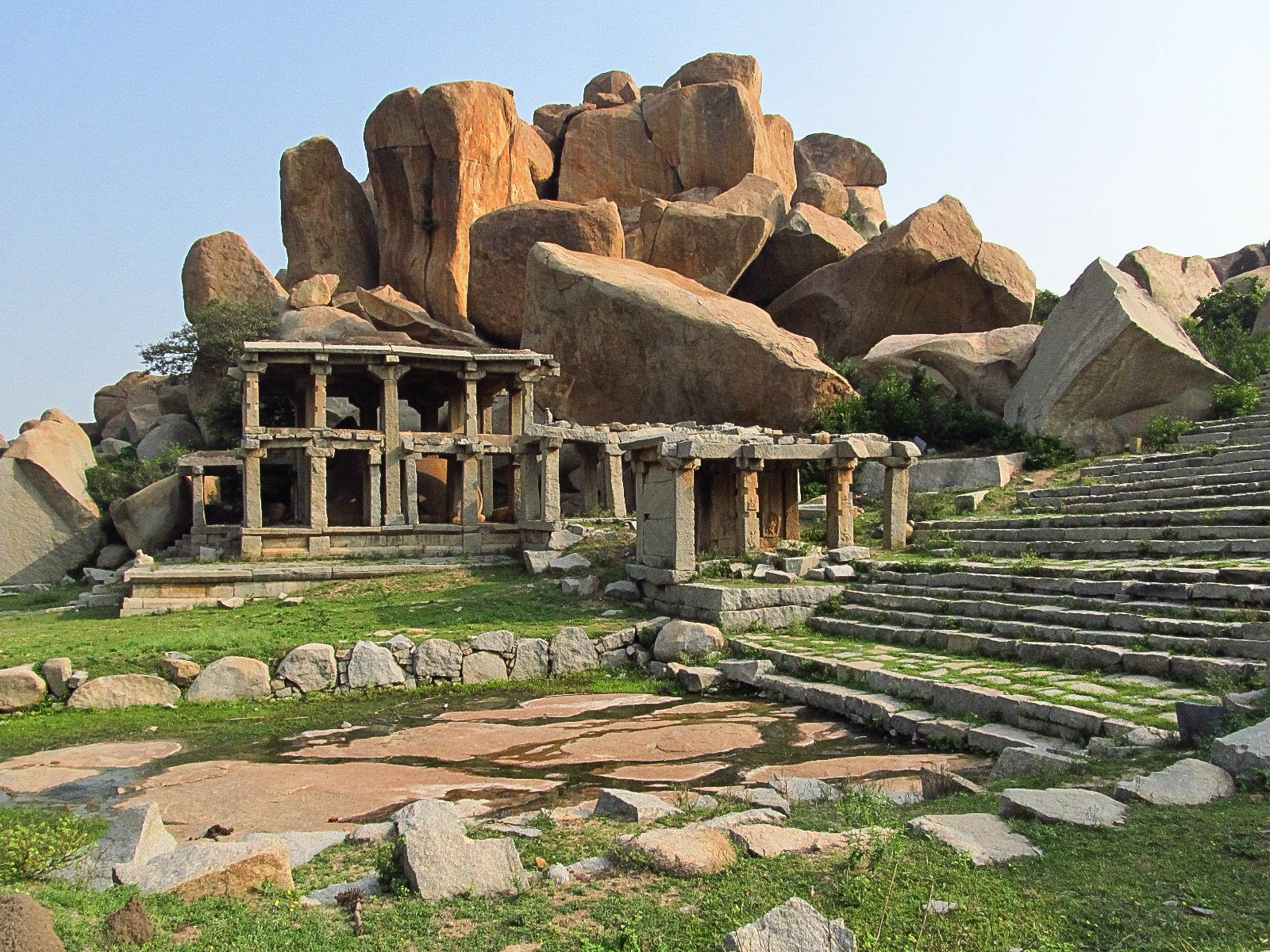
Further on, the journey culminates in Hampi—the vast and surreal ruins of the Vijayanagara empire.
Here, the scale shifts again.
Granite boulders rise in improbable formations. Temples emerge from the landscape as if carved from it. The remains of a once-great city stretch across valleys and ridges, their presence both monumental and strangely intimate.
Arriving in Hampi by bicycle—after days of gradual approach—changes the experience entirely. It is no longer a site to visit, but a place you have entered.
A photographic journey as much as a ride
The newly published Cycling Goa to Hampi reflects this journey in a different way than traditional guidebooks.
With over 140 images, the book is as much a visual exploration as it is a narrative. The photographs are not captions to the text—they are part of the storytelling.
They follow the same progression:
coast to mountains,
mountains to plateau,
plateau to temples,
temples to Hampi.
Rather than listing logistics or exhaustive options, the book focuses on what the journey feels like:
the texture of the road,
the faces encountered along the way,
the shifting light across stone and landscape,
the sense of movement through a living environment.
Ride it—or simply travel through it
Not everyone will cycle this route.
But even if you don’t, it remains one of the most compelling ways to understand this part of India. Whether you follow it in full or in part, it offers a perspective that is difficult to find through conventional travel.
If you do ride it, the route becomes something else entirely:
a continuous thread connecting coast, culture, and history through your own effort.
One Reply to “Cycling Goa to Hampi: Across Karnataka’s Temple Heartland”