India resists introduction. It is too large, too layered, too contradictory to be reduced to a neat beginning. And yet every traveler who arrives—whether by plane into the neon haze of Delhi, or by some slower, older passage—carries a private moment that becomes their India. That first encounter tends to define everything that follows.
There is a familiar phrase: you either love India or you hate it. It is repeated often, almost lazily. But in truth, the reaction is rarely that simple. India does not ask for approval. It confronts, overwhelms, seduces, irritates, humbles—and then, often quietly, it stays with you.
For me, it began not with ease, but with friction. I entered India in the early 1970s overland, crossing from Lahore into Amritsar at the Wagah Border. At that time, I was the only Westerner attempting the crossing. India and Pakistan were exchanging prisoners after war, and the border was not a place of transit—it was a place of tension, bureaucracy, and waiting.
It took a week to cross. There were lines of lorries stretching in both directions, pedestrians gathered in uncertain clusters, and very little in the way of shelter or comfort. Food was dubious, lodging nonexistent. Time seemed suspended in that strip of land between two nations still measuring each other in the aftermath of conflict.
And then, suddenly, I was across. On the Indian side, I found my way to the Golden Temple in Amritsar. I stayed there for a week. It was not luxury—far from it—but it was something else entirely: calm, rhythm, humanity. The temple’s marble floors, the reflection of the sanctum in the water, the constant movement of pilgrims, the quiet generosity of langar meals served to all without distinction.
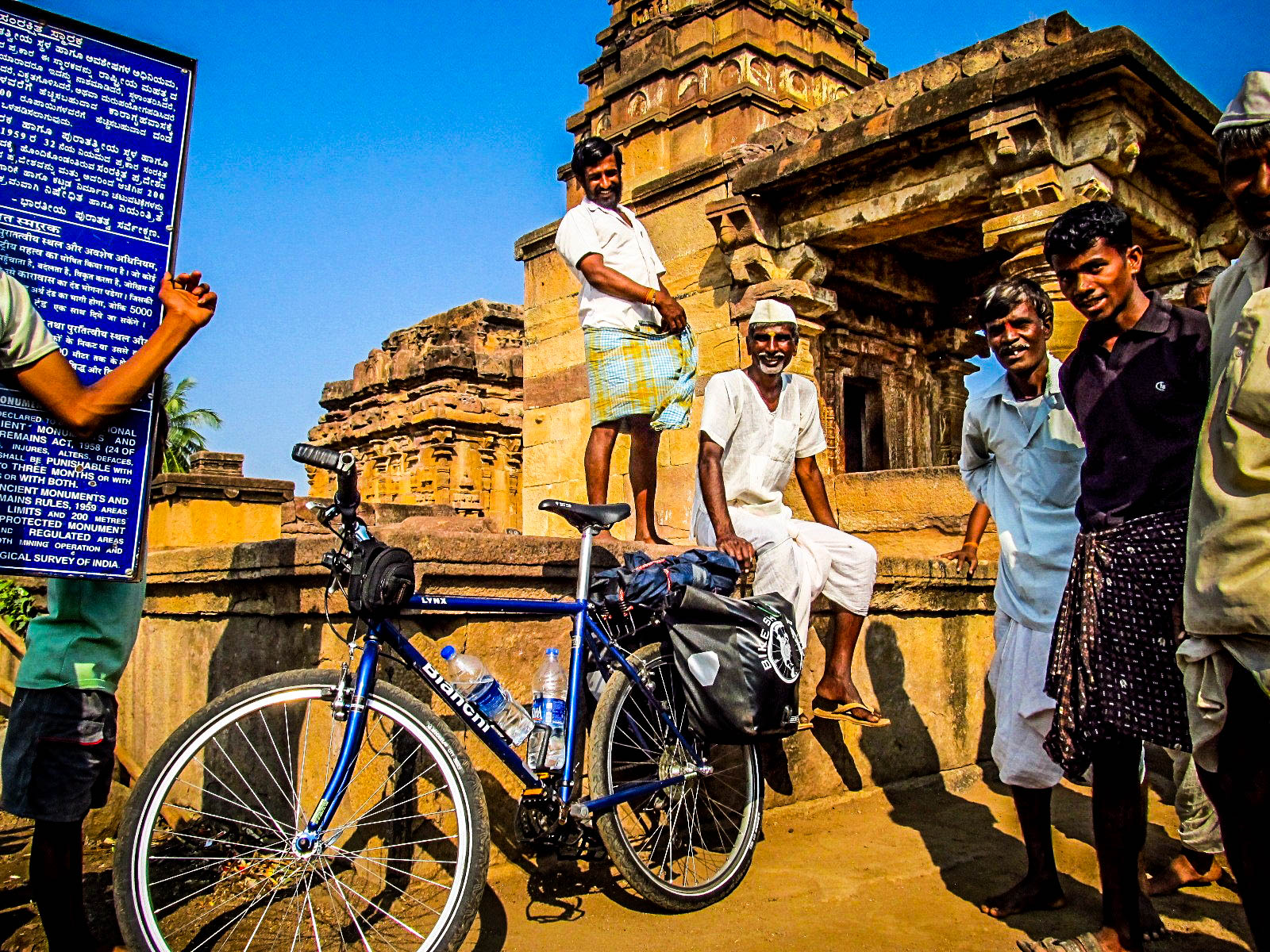
It was my first lesson in India: that extremes coexist without apology. Since that first crossing, I have returned to India countless times. Not once or twice, but again and again, over decades—by train, by bus, on foot, and most meaningfully, by bicycle. I have crossed the country in multiple directions, tracing its plains, climbing into its hills, following coastlines and cutting through interior landscapes where time seems to move differently.
And still, each arrival feels like a beginning.
What People Love — And What They Resist
India is not subtle. It does not unfold gently. It presents itself in full volume from the outset. What draws people in is often the same thing that unsettles them. There is an intensity to daily life—colors that seem over-saturated, sounds that rarely subside, a density of human presence that leaves little room for detachment. Streets are not merely for movement; they are stages where commerce, ritual, negotiation, and improvisation play out simultaneously. For some, this is exhilarating. For others, it is exhausting.
There is beauty everywhere, but it is not curated. It appears in fragments: a temple doorway half-hidden behind market stalls, a quiet stretch of river at dawn, a roadside tea shared with strangers. You do not move through India as an observer alone—you are drawn into it, whether you intend to be or not.
And then there is the rhythm of life, which does not align neatly with expectation. Things take time. Plans shift. Systems that appear chaotic often reveal their own internal logic—one that only becomes visible after patience replaces resistance. This is where many first impressions are formed. Not in monuments or landscapes, but in the small negotiations of daily travel: finding a place to stay, ordering food, navigating transport, simply understanding how things work.
India asks something of the traveler: adaptability, humility, and a willingness to let go of control.
A Country Crossed by Bicycle
Over the years, my way of understanding India became tied to the bicycle. It is perhaps the most honest way to move through the country—slow enough to notice, fast enough to traverse distance, exposed enough to feel everything. The routes I have followed—and later shaped into guidebooks—trace different faces of India:
- The humid plains stretching toward Nepal, where the landscape opens wide and the horizon seems distant and soft
- The northeastern hills of Assam and Meghalaya, where mist and forest blur the edges of the road
- The dry expanses of Rajasthan, marked by forts, palaces, and thorn scrub, where cycling, the road becomes the journey.
- The Konkan coast, where the Arabian Sea appears and disappears between cliffs and villages
- The climb over the Western Ghats, where heat gives way to altitude, and the air shifts almost imperceptibly
These journeys became more than routes. They became a way of reading the country—not through a single narrative, but through a series of movements, each revealing something partial, something incomplete, yet meaningful.
Among them are routes that later took shape as guides:
- Cycling across Terai, West Bengal to Kathmandu
- Bhutan by Bicycle
- Cycling India: Goa to Hampi
- Cycling Hampi to Mysore
- Cycling Konkan Coast: Mumbai to Goa
- Bicycle Touring Northeast India
- Cycling Mysore to Fort Kochi
- Cycling Rajasthan: Udaipur to Karauli
Each follows a line across the map. But India is not contained within those lines.
Returning, Again and Again
If there is one constant in my experience of India, it is this: it does not reveal itself all at once. Nor does it remain the same. The India I first encountered in the 1970s is not the India of today. Cities have expanded, roads have improved, economies have shifted. And yet, beneath these changes, something persists—a continuity that is difficult to define but unmistakable when you encounter it. Perhaps that is why people return. Not to confirm what they already know, but to see what has changed—and what has not.
For me, India has never been a single story. It is a series of encounters, spread across time. Some vivid, some quiet, some difficult, some unexpectedly generous. This post is not meant to explain India. It cannot. It is only a beginning—a doorway into a series of reflections, journeys, and fragments that will follow. Stories from the road, from villages and cities, from mountain passes and coastal tracks. Moments that, taken together, might suggest something of what India is—and what it continues to be. Not a place to be understood in one visit. But a place that, once entered, has a way of staying with you.