There are faster ways to travel between Mumbai and Goa.
A short flight.
An overnight train.
A long bus ride that erases the distance in a single stretch.
Most travelers choose one of these, and in doing so pass over a stretch of coastline that remains, even now, just outside the main current of travel—the Konkan coast.
Pressed between the Arabian Sea and the long wall of the Western Ghats, the Konkan unfolds quietly. It does not present itself all at once. It reveals itself in fragments: a fishing village at the edge of an inlet, a road winding beneath coconut palms, a ferry crossing that interrupts the day without apology. For long stretches, there is simply space—between places, between encounters, between moments.
It is this continuity, more than any single highlight, that defines the experience.
The Ride
Cycling from Mumbai to Goa is not about covering distance. It is about moving through a landscape at a pace that allows it to take shape.
The journey begins at the Gateway of India, crossing the harbor to Mandwa, where the city quickly gives way to quieter roads. From there, the route follows the coastal spine southward—through Alibag, Murud-Janjira, Harnai, Guhagar, and beyond—before eventually reaching the southern edge of Maharashtra near Vengurla.
Along the way, the coastline bends and folds.
There are no continuous roads here. The land gives way to water, and the ride pauses at ferry crossings—small boats carrying people, bicycles, and the occasional vehicle across wide estuaries. Progress is never entirely linear. You follow the shape of the coast, and the coast decides the rhythm.
The terrain is never extreme, but it is never flat. Short climbs rise over low headlands, followed by descents toward the sea. Inland stretches offer relief from the heat, while the return to the coast brings the horizon back into view.
And always, there is the heat—part of the experience, shaping the day, dictating when to ride and when to stop.
Why This Route Still Matters
The Konkan is changing.
Roads are improving, access is easier, and development is slowly extending south from Mumbai and north from Goa. It is not difficult to see what this coastline may become in time.
But for now, much of it remains as it has been—quiet, local, and largely unmediated.
There are no curated stops here. No carefully constructed experiences. What you encounter is simply what is there: villages that exist for themselves, not for visitors; roads that connect places rather than showcase them; a coastline that reveals itself gradually, without explanation.
To cycle through it is to experience that continuity directly.
The Book
I first rode the Konkan coast years ago, as part of a longer journey through South India. It stayed with me—not because of any single moment, but because of how the entire stretch unfolded.
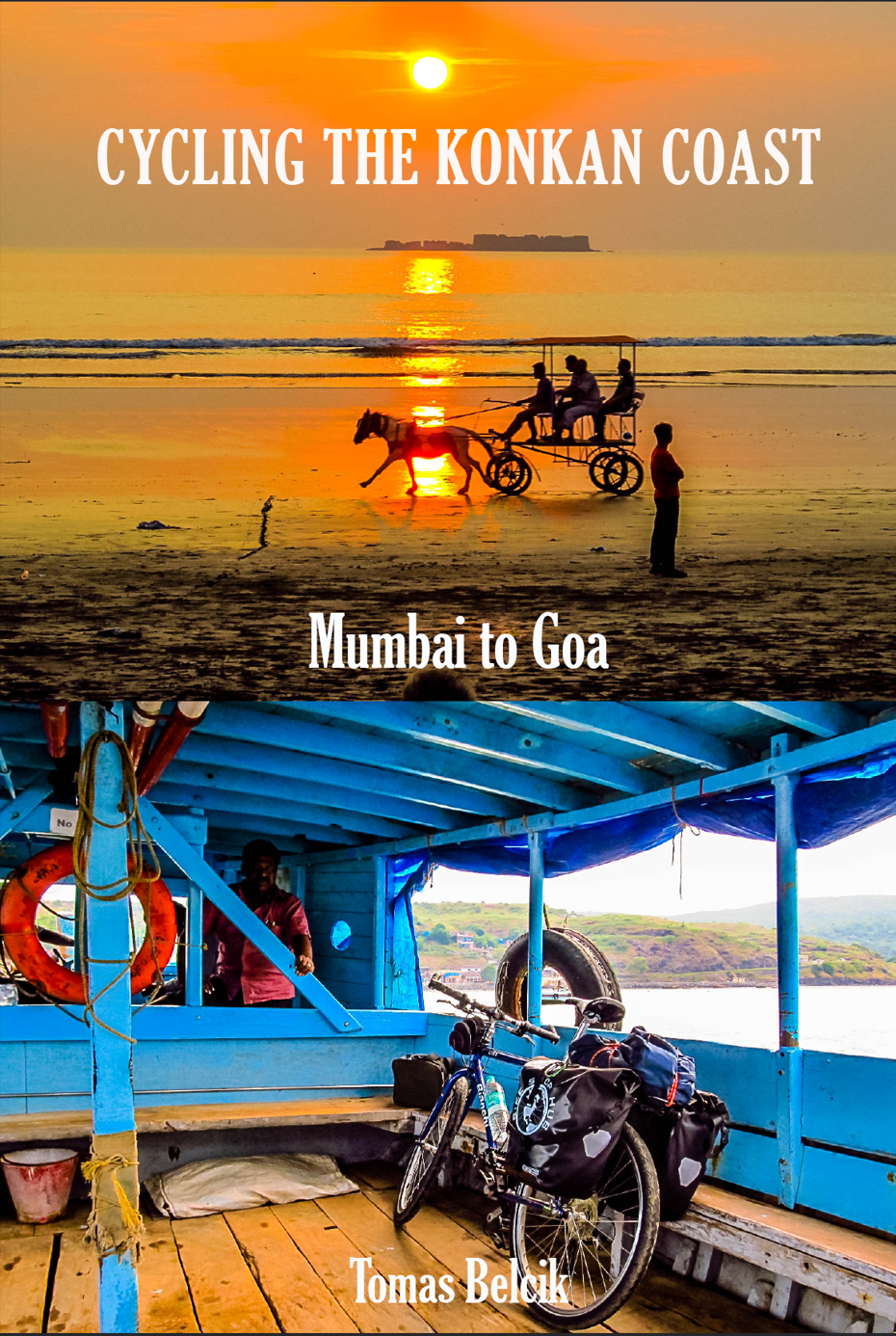
This new paperback, Cycling the Konkan Coast: Mumbai to Goa, a PDF, is a reworked and updated version of that original journey.
It is not a traditional guidebook.
There are no exhaustive listings, no step-by-step instructions. Instead, the book follows the route as it is experienced—stage by stage, with practical detail where it matters, but always grounded in the ride itself.
The aim is simple: to give you a clear sense of what it feels like to travel this coastline by bicycle.
In the End
Cycling the Konkan coast is not the fastest way to reach Goa.
It is not the easiest.
But it is, in every sense, a more direct one.
A way of arriving not just at a destination, but through a landscape—one that, for now, still allows itself to be experienced on its own terms.
One Reply to “Cycling the Konkan Coast: Mumbai to Goa”