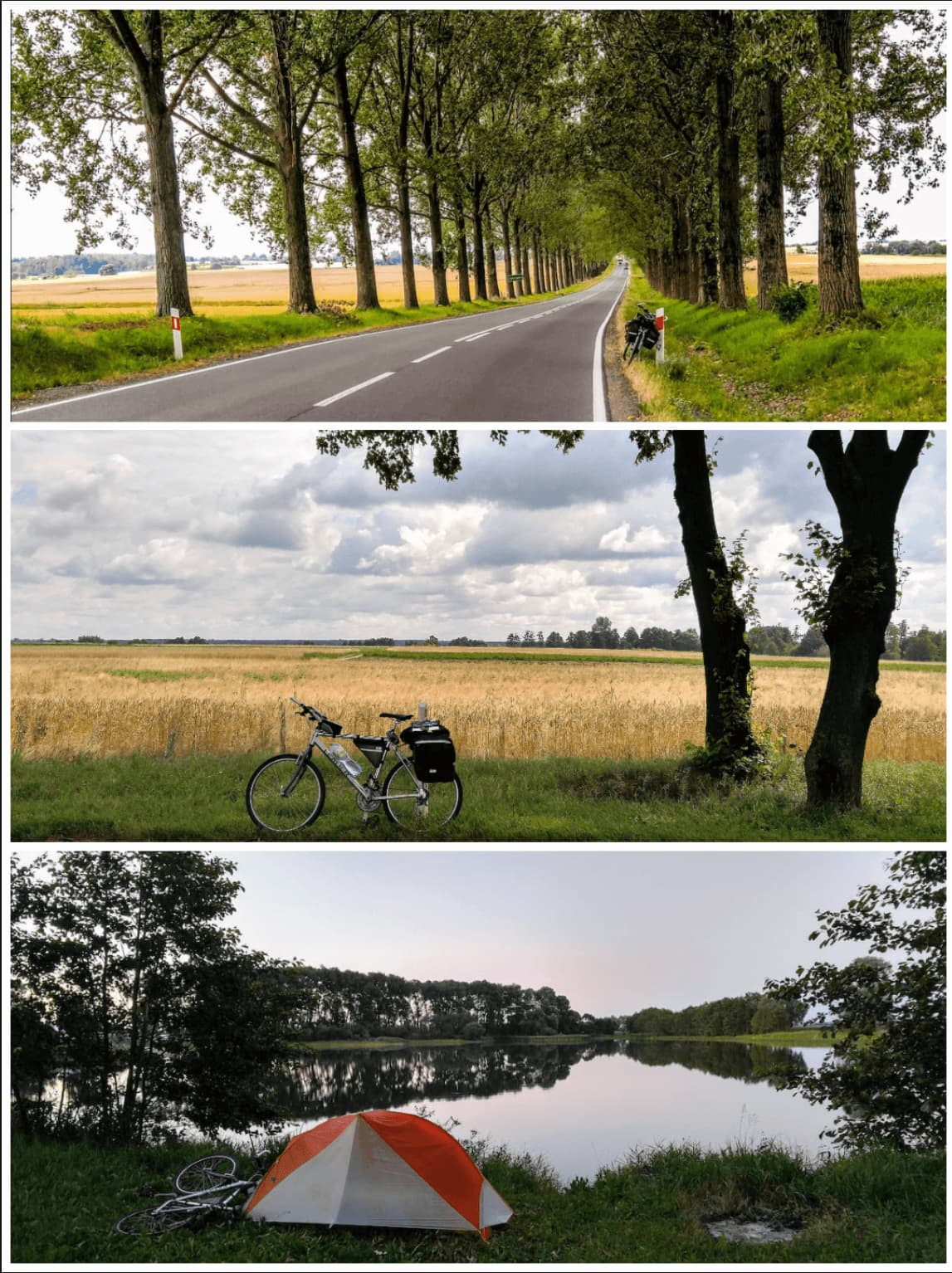
There is something about leaving a landlocked country by bicycle that makes the sea feel farther away than the map suggests. From Prague, I have cycled south toward Venice and the Adriatic, southeast through the Balkans to Athens, east toward Odessa and the Black Sea, and west across Europe toward the Atlantic. Those journeys possessed a certain geographical drama from the beginning. The Alps stood between Prague and Venice. The Balkans lay on the road to Athens. Odessa meant crossing an increasingly unfamiliar Eastern Europe before finally reaching the Black Sea. Heading west, the Atlantic seemed almost the natural end of the continent.
Poland was different. Mention cycling through France and the imagination immediately supplies vineyards, village cafés and famous mountain passes. Mention Italy and images arrive almost as quickly. Spain, the Alps, the Danube, even the windswept Atlantic coast of Ireland—all come with an established mythology of bicycle travel. But Poland? That question was partly why I wanted to cross it.
Poland does not overwhelm the touring cyclist with scenery. Much of the country is flat. There are long stretches of cultivated fields, forests, villages and modest towns. There may be no mountain pass ahead to conquer and no famous coastline waiting around the next bend. Some days the road simply continues toward the horizon. Yet that apparent ordinariness gradually becomes part of Poland’s attraction. Travel slowly enough and other things begin to take precedence. A Rynek appears in a town you had barely noticed on the map. An old wooden church stands in an otherwise insignificant village. A stranger wants to know where you are cycling. A shopkeeper attempts to understand your Czech-inflected Polish. Two men drink vodka at a bus shelter before breakfast. Somewhere else, hundreds of pilgrims walk along the roadside carrying banners and images of the Black Madonna. You begin to realize that Poland is not presenting itself for your benefit. You are simply moving through it while everyday Polish life continues around you. That is one of the great pleasures of traveling there by bicycle.
History Beneath the Wheels
It is almost impossible to cross Poland without riding through history. I entered from the Czech side of Silesia, a region that over the centuries has belonged to different kingdoms, empires and states. Czech, Polish and German names overlap. Borders moved while towns remained where they were. Farther north came Częstochowa and the extraordinary sight of pilgrims converging on Jasna Góra. Some had walked for days carrying tents and sleeping bags, led by parish priests, singing as they approached one of Catholic Poland’s great spiritual centers. Then came the Vistula—the Wisła to the Poles—and beyond it the brick Gothic world of Toruń and the lands once dominated by the Teutonic Knights. Kwidzyn, Sztum and the immense fortress at Malbork were reminders that the seemingly quiet countryside had once stood at the center of struggles involving Poles, Prussians, Germans, Teutonic knights and kings.
And eventually there was Gdańsk. Few European cities carry so many layers of history in their stones: Hanseatic trade, German and Polish identities, destruction and reconstruction, the opening shots of the Second World War nearby, and, generations later, the Solidarity movement that helped loosen communism’s grip on Eastern Europe. On a bicycle, these aren’t isolated attractions visited from a tour bus. They become points along a continuous line. You ride the countryside between them. That makes a difference.
The Poland Between the Sights
Some of my strongest memories aren’t of the celebrated places at all. They are of people. A cyclist stopped what he was doing to lead me to a hotel I would never have found. Another helped me negotiate the urban maze around Gdynia. A farmer, after watching me get hopelessly turned around near the Nogat River, finally intervened and guided me along an almost invisible path to the locks. In Silesia, I visited distant relatives I had never met and listened as family memories merged with Polish history—the Warsaw Uprising, Katyn, occupation, resistance and the long communist aftermath. Elsewhere, conversations were far less consequential. Someone wanted to discuss Czechoslovakia. Someone else wanted to know why on earth I was riding to the Baltic. People offered directions, coffee, advice, opinions and occasionally beer. Those encounters are difficult to plan and impossible to put on an itinerary. They are also one reason I increasingly believe that too much preparation can diminish a journey. When every night’s accommodation is reserved and every attraction has been researched beforehand, travel can become an exercise in fulfilling expectations. A bicycle leaves room for things to go wrong. And therefore for things to happen.
Riding Toward the Sea
Perhaps because I grew up in landlocked Czechoslovakia, reaching the sea has never felt entirely ordinary to me. As a child, Poland was the first foreign country I visited with my parents, at a time when there were very few countries we were permitted to visit. We traveled north to the Baltic and stayed at Sopot. I still remember tasting seawater for the first time. We also visited Hel. Decades later, that childhood memory gave my bicycle journey a destination. Not Warsaw. Not Gdańsk. Not even the Baltic coast itself. Hel. The name alone was irresistible. But first I had to get there.
After reaching Gdańsk, the character of the ride changed. I passed through Sopot, where fragments of childhood memory competed with the modern seaside resort around me, then continued through Gdynia and along the coast toward Puck. At Władysławowo, the land narrows. Ahead lies the Hel Peninsula, a sandy finger extending some 36 kilometers into the Baltic. At points it is barely wide enough to accommodate the road, railway, bicycle path and forest separating one shore from the other. The final ride is almost entirely beneath pine trees. There is no great climb. No heroic mountain pass. No dramatic physical challenge. You simply pedal along a narrow strip of sand surrounded by water until eventually there is nowhere farther to go. It was perhaps the most subdued climax of any of my long-distance rides. And I liked it that way.
Poland Is Not France—and That’s the Point
Would I recommend crossing Poland by bicycle? Absolutely—but perhaps not for the reasons cyclists normally choose a destination. Don’t go expecting the visual spectacle of the Alps. Don’t expect Tuscany around every bend or the romance that has already been assigned to Provence. Don’t expect every town to understand what a touring cyclist wants, or every road to have a perfect bicycle lane. Poland asks for a little more patience. In return, it offers something increasingly difficult to find in heavily traveled parts of Europe: the sensation that the country exists independently of tourism. The small towns are not waiting for you. The farmers are working. People are shopping, drinking coffee, attending church, arguing, going home from work, walking pilgrimages, smoking outside shops, taking their children to the Baltic for their summer holidays. You pass through their world rather than through a landscape arranged for visitors. There are magnificent exceptions, of course—Toruń, Malbork, Gdańsk, Wrocław, Kłodzko—but even those places belong to a larger journey rather than defining it. That may be what I remember most about cycling Poland.
The Geography of Leaving
There is a peculiar freedom in setting off from somewhere familiar and watching familiarity slowly disappear. Leaving Prague for Venice, the road eventually climbs toward the Alps and drops toward Italy. Heading for Athens, Central Europe gradually gives way to the Balkans and, farther south, to a different cultural world. Toward Odessa, the transition unfolds eastward through languages, histories and political frontiers. Heading for the Atlantic, Europe seems to stretch endlessly west until land finally runs out. Cycling north through Poland is subtler. There is no single moment when everything changes. The mountains flatten into Silesia. Industrial towns give way to agricultural country. Pilgrims appear along the roads. The Vistula announces another historical region. Brick Gothic churches and Teutonic castles begin to punctuate the landscape. Eventually the air changes, the horizon opens, pine forests appear behind sand dunes—and there is the Baltic. Perhaps that is why Poland lends itself so well to bicycle travel. Its rewards accumulate. A bicycle is slow enough to notice them. And then, after hundreds of kilometers of fields, forests, towns, conversations, wrong turns and unexpected discoveries, you find yourself on a sliver of sand surrounded by the Baltic Sea. At Hel. With one l. And no, getting there wasn’t hell at all.