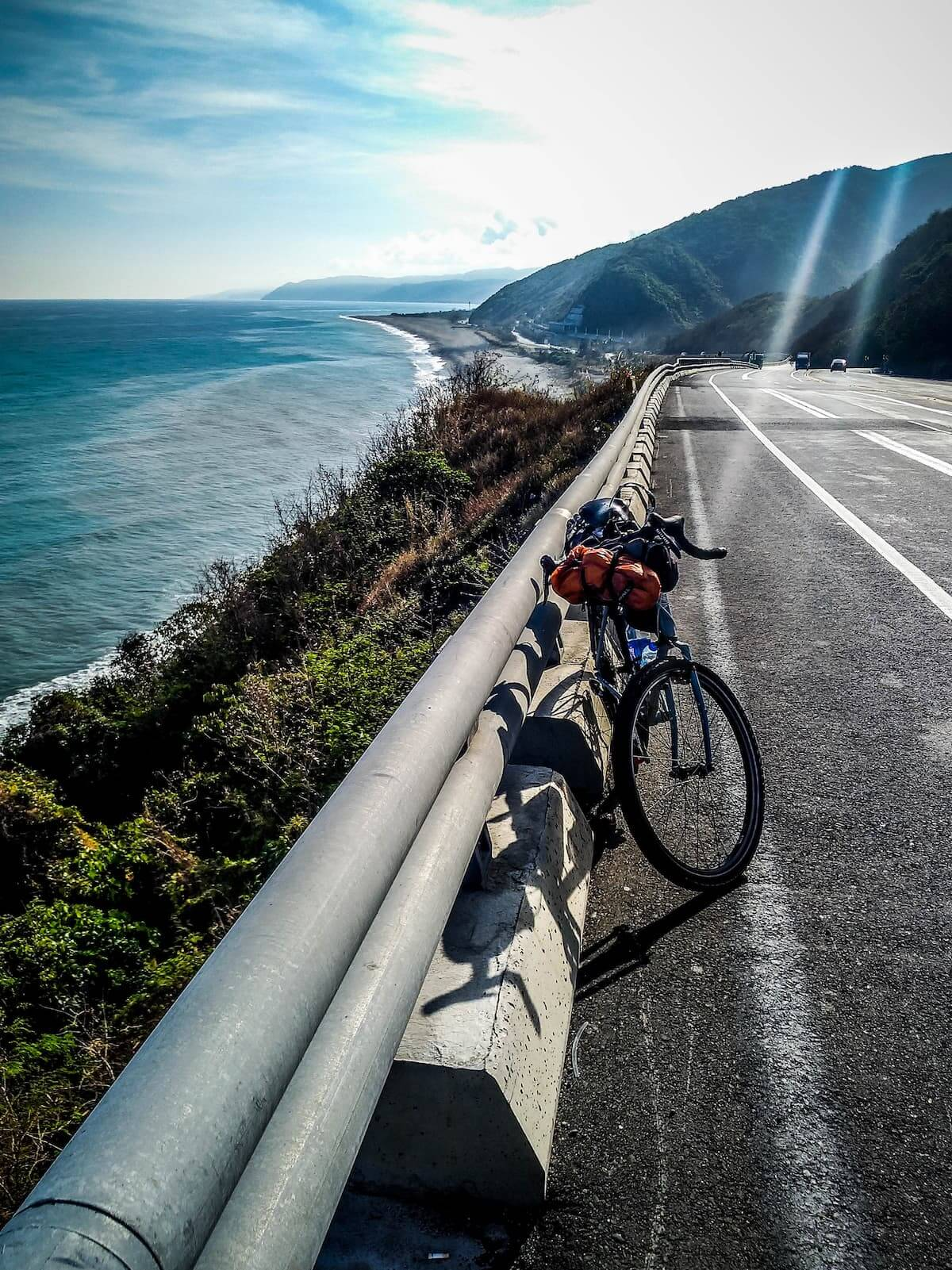
There are countries where traveling by bicycle means finding a way through a landscape never designed with cyclists in mind. And then there is Taiwan. Here, an entire island seems to have embraced the idea that going around it by bicycle is a perfectly reasonable thing to do. Taiwan’s Cycling Route No. 1 circles the country, supported by marked cycling lanes, rest stops, convenience stores, railway connections and even police stations designated to assist cyclists. When I first began reading about it, I imagined something close to a cyclist’s heaven. The official enthusiasm went further. A reasonably fit cyclist, it was suggested, could complete the roughly 1,200-kilometer circuit in nine days. Nine days? Perhaps. But why? I had come to Taiwan to cycle around an island, not simply to prove that I could get back to where I started.
And therein lies what I came to appreciate most about cycling Taiwan: Route No. 1 may provide the line to follow, but the reasons for riding it are found by looking beyond the line.
An Island Made for Cycling
Taiwan has good reason to identify itself with bicycles. It is home to GIANT, one of the world’s major bicycle manufacturers, and cycling has become embedded in the country’s recreational culture. When Cycling Route No. 1 was inaugurated in 2015, it built upon years of developing local bicycle routes and dedicated paths. The infrastructure can be impressive. Painted cycling lanes appear along busy roads. Convenience stores become informal rest stations. The railway is rarely far away, providing an escape if weather, fatigue or mechanical problems interrupt the journey. Yet “cycling infrastructure” can create a misleading picture of what riding around Taiwan actually feels like.
Taiwan is densely populated. Much of the western side of the island is an almost continuous succession of cities, towns, factories, shops, temples, scooters and traffic. Bicycle lanes do not necessarily mean quiet bicycle paths. Sometimes your allotted piece of pavement is separated from fast-moving traffic by little more than a painted white line. In cities, scooters surround you and traffic seems to flow according to a rhythm you have to learn. The drivers, I found, were courteous. But cyclists expecting an idyllic European-style separated cycleway around the entire island may initially be surprised. And that, too, is part of Taiwan.
The West Coast: Don’t Rush Through It
Before setting out, I had read repeatedly that Taiwan’s east coast offered the spectacular scenery. I initially considered riding clockwise from Taipei so that I could reach it first. Instead, I followed the recommended counterclockwise direction and headed down the western side. I am glad I did. The west may not provide the immediate drama of mountains plunging toward the Pacific, but judging it merely by scenery misses its fascination. This is where much of Taiwan’s urban life, history, temples and food culture crowd around the bicycle. Hsinchu introduced me to that mixture particularly well. Around the City God Temple, worship and everyday life seemed almost inseparable from eating. Incense, offerings and elaborate religious imagery existed alongside a maze of food stalls and small eateries. That pattern repeated itself. Taiwan’s temples are not monuments standing apart from daily life. They erupt from streetscapes in brilliant reds and golds, guarded by lions, dragons and fantastic rooftop figures. Some are grand pilgrimage destinations; others appear unexpectedly beside highways, warehouses or fishing villages. At Dajia, persistent rain forced me to stop riding, giving me time to return repeatedly to the famous Jenn Lann Temple. Elsewhere, little roadside shrines became splashes of color against industrial and coastal landscapes. Traveling slowly enough to notice these places became far more important than maintaining an impressive daily average.
Ride to Eat, Eat to Ride
Then there is the food. I have joked that anyone cycling around Taiwan risks becoming a food addict. It isn’t much of an exaggeration. Night markets, temple markets, noodle shops, dumplings, seafood stalls and tiny restaurants continually interfere with the cyclist’s intention to make progress. Hsinchu, Tainan, Kaohsiung and numerous smaller towns supplied reasons to stop that had nothing to do with fatigue. Cycling makes this particularly satisfying. Ride for hours, become hungry, eat. Ride again and discover something else worth eating.
Ride to Eat. Eat to Ride. Few places I have cycled give that expression quite as much meaning as Taiwan. Food also changes the nature of the journey. A cyclist is rarely sealed away from ordinary life. You stop because you are hungry, wet, lost or simply curious. You sit down where other people are eating. A convenience store becomes shelter from a storm; a temple market becomes lunch; an unassuming town that appears deserted in the afternoon comes alive after dark when its restaurants open. The bicycle continually provides excuses to participate rather than merely observe.
Typhoon Alley
If Taiwan’s cycling infrastructure sometimes made the island seem almost too accommodating, the weather quickly corrected that impression. Along the northwest coast I entered what I came to think of as Typhoon Alley. Offshore wind turbines should have been warning enough. At times the sidewind became so powerful that I stopped behind concrete barriers simply to brace myself, worried that a gust might blow me across the pavement toward passing traffic. Elsewhere the same winds became extraordinary tailwinds. This was the other Taiwan, beyond the reassuring Route No. 1 signs: an island exposed to ocean weather, where rain can transform a comfortable day’s ride and where the season matters. I was riding late in the year, from late November through December. Rain became part of the journey. So did waiting. But bicycle travel is shaped as much by what interrupts the itinerary as by what follows it.
Crossing to the Other Taiwan
Eventually the route reaches Taiwan’s southern end, and the character of the journey begins to change. Beyond Kaohsiung and the developed western plains, I continued toward Hengchun and the southern tip before crossing the mountains toward Taitung. That stage was one of the hardest of my circuit: roughly 118 kilometers with about 1,760 meters of climbing. But the crossing also felt like a geographical threshold. The crowded western side was behind me. Ahead lay the east. Taiwan is a remarkably narrow island for the amount of topography compressed into it. A mountainous spine dominates its interior, leaving very different worlds on either side. On the west are the great concentrations of population and industry. On the east, mountains squeeze settlement into a much narrower corridor between the interior and the Pacific. This is the Taiwan cyclists tend to dream about before arriving. Yet after riding the west, I wouldn’t trade one for the other. The contrast is what makes circling the island worthwhile.
The East Coast Isn’t the Whole Story
From Taitung I rode north through the eastern valleys toward Yuli and Hualien. The landscape opened. Mountains became constant companions. The density of the west diminished. Towns felt smaller and distances between them more pronounced. It would be easy, after reaching the east, to conclude that this is the beautiful Taiwan and everything before it was merely the price of admission. I don’t see it that way. The old towns, temples and extraordinary food of western Taiwan were every bit as important to my experience as the landscapes of the east. The west showed me Taiwan as a densely populated, intensely lived-in society. The east revealed the physical island beneath it. To understand something of Taiwan from a bicycle, I think you need both. That is also why I would ride the circuit counterclockwise again.
Sometimes the Sensible Route Is a Train
There is another misconception worth abandoning: that circumnavigating Taiwan requires religiously cycling every kilometer. North of Hualien, Highway 9 presents a section where narrow coastal roads, long tunnels, trucks, poor margins and winter weather can make cycling unpleasant and potentially dangerous. I saw little virtue in proving a point. The normal solution was also the sensible one: put the bicycle on a train and bypass the worst section toward Su’ao, then continue riding. Taiwan’s railway is not an admission of defeat for the touring cyclist. It is part of what makes bicycle travel around the island so flexible. The objective, after all, is to experience Taiwan—not to satisfy some imaginary official scrutinizing your GPS track.
The Last Mountains
From Jiaoxi, the circle still wasn’t quite complete. Between me and Taipei lay one final mountain traverse. The Beiyi Highway climbs through the celebrated Nine Bends and Eighteen Turns, rising from near sea level toward the mountains. With every switchback the panorama over the Lanyang coastal plain widens, with the coast and Guishan Island changing perspective below. After weeks of riding south, crossing the island and working my way north again, climbing away from the coast carried a different feeling. A circular journey has a peculiar psychology. On a point-to-point bicycle tour, the destination is always somewhere new. On an island circuit, the destination is where you began—but you return to it with an entirely different mental map. Taipei was no longer simply the city where I had assembled my bicycle and set out. It had become the closing point of a landscape I could now imagine as a whole.
More Than a Cycling Route
In the end, I cycled nearly 1,500 kilometers around Taiwan, including riding done during stops along the way. My principal circuit unfolded over 15 stages rather than being compressed into an official nine-day challenge. I wouldn’t have wanted it otherwise. Could a strong cyclist ride Taiwan’s Route No. 1 much faster? Certainly. But speed seems a particularly strange measure of success on an island where a temple may stop you for an hour, a night market for an evening, rain for a day, and a mountain road simply because the view demands it. Taiwan succeeds as a cycling destination partly because it has made bicycle travel unusually approachable. The route signs, trains, convenience stores and cycling infrastructure remove some of the uncertainties that make independent bicycle touring intimidating. But those conveniences aren’t ultimately what make the journey memorable. What remains is the contrast: Taipei and quiet mountain roads; industrial western cities and the open east; elaborate Mazu temples and 7-Elevens; tropical coastlines and cold December rain; scooters and bicycles; mountains and night markets. Route No. 1 gives you a way around Taiwan.
The reason to ride it is everything that makes you stop along the way.
Planning to ride around Taiwan? My downloadable Bicycle Taiwan’s Cycling Route No. 1 guide follows the journey in 15 stages, with route details, accommodations and downloadable GPS tracks.