When people think of Japan, they usually picture Tokyo’s neon skyline, Kyoto’s temples, or perhaps the crowds crossing Shibuya.
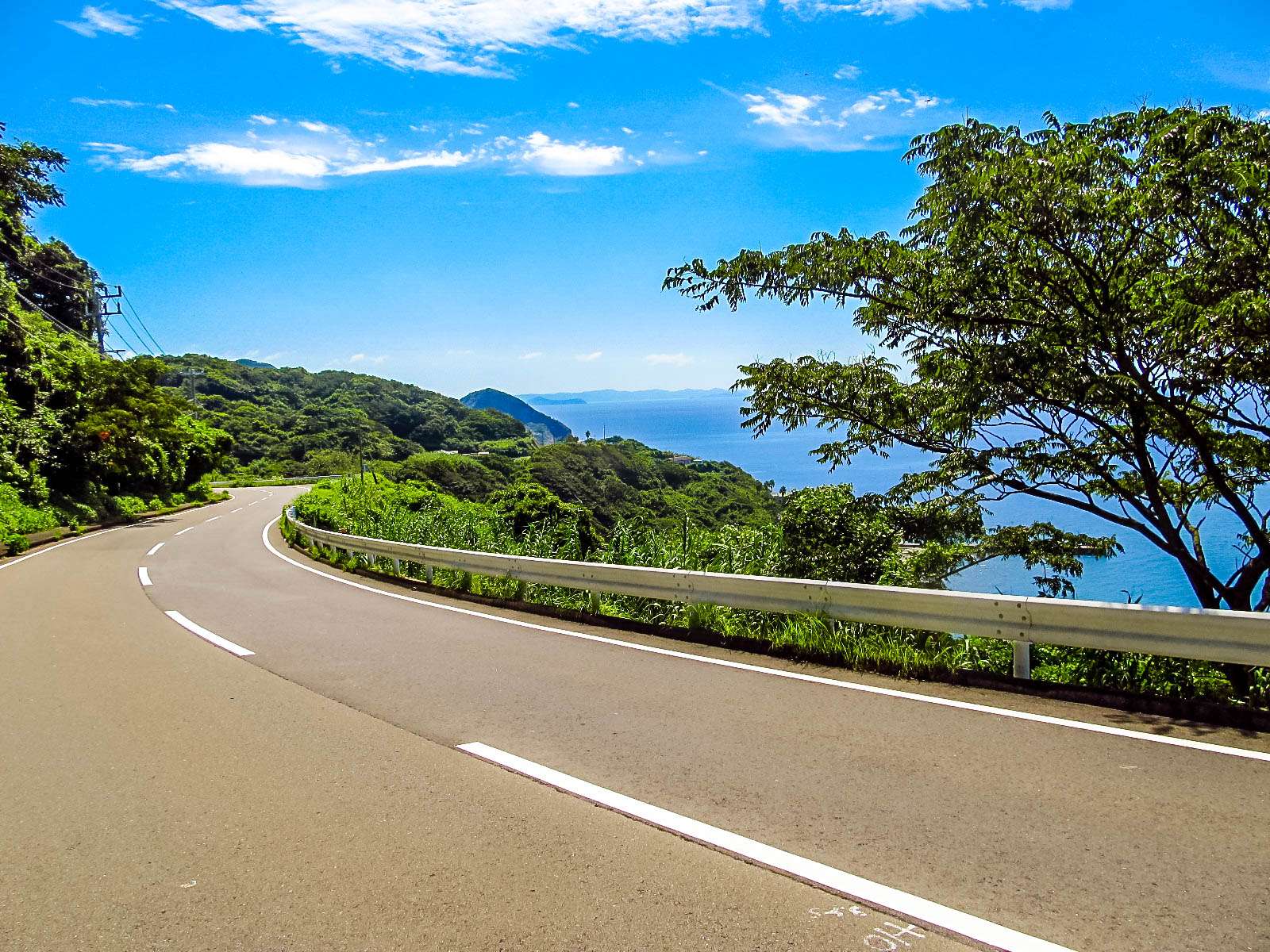
Yet some of my most memorable days in Japan were spent far from the country’s famous cities, pedaling along empty coastlines, through fishing villages, past steaming hot springs, and beneath the slopes of active volcanoes.
That is what drew me to cycling Kyushu.
Japan’s southernmost main island is often called the Land of Fire. Volcanoes have shaped its landscape for millennia, creating dramatic mountain scenery and some of the finest hot springs in the country. Yet for a cyclist, Kyushu offers much more than volcanoes. It is an island of rugged coastlines, offshore islands, historic ports, quiet farming valleys, and roads that seem made for bicycle travel.
My journey around Kyushu began in South Korea. After cycling across much of the Korean Peninsula, I boarded the overnight ferry from Busan to Fukuoka and arrived in Japan at sunrise. Standing on the deck as Kyushu emerged from the morning haze felt like the beginning of a new adventure.
Why Cycle Kyushu?
What struck me most about Kyushu was its variety.
One day I would be cycling beside the sea, passing fishing ports and tiny harbors where squid dried in the sun. The next day I would be climbing into forested mountains or crossing high volcanic plateaus.
The northwest coast around Karatsu, Matsura, and Hirado was among my favorite parts of the island. The roads were quieter than I expected, the scenery superb, and the villages retained a distinctly maritime character. Farther south, Nagasaki offered a fascinating blend of Japanese, Chinese, and European influences unlike anywhere else in Japan.
The route then led through the Amakusa Islands, one of the most beautiful coastal regions I encountered anywhere in the country. Here, narrow roads hugged rocky shorelines while fishing villages seemed suspended between sea and mountains.
The farther south I traveled, the more remote the journey became. Cape Toi, with its wild horses grazing above the ocean, felt a world apart from the urban centers of northern Kyushu.
Eventually the route turned inland toward Takachiho and Mount Aso, where the island reveals its volcanic heart.
What Makes Cycling in Japan Different?
Over the years I have cycled in dozens of countries, but Japan remains unique.
The roads are generally excellent. Even minor roads are paved and well maintained. Public bathrooms are frequent and remarkably clean. Convenience stores are everywhere and provide reliable access to food, drinks, and supplies.
Yet what I remember most is not the infrastructure.
It is the people.
Throughout Kyushu I repeatedly experienced small acts of kindness. A shopkeeper pointing me in the right direction. An onsen attendant charging my phone while I soaked in the hot pools. Local residents stopping to ask where I had come from and where I was going.
Even more striking was the road etiquette.
Drivers routinely slowed down, waited patiently, and often waved me through first. If one car stopped, every vehicle behind it stopped as well. I never heard a driver honk at me anywhere in Kyushu. On the contrary, drivers often smiled as they passed.
Years later, while cycling parts of Honshu along the Nakasendo and Tokaido routes, I found traffic noticeably busier and drivers somewhat less accommodating. Kyushu, by comparison, felt calmer and more relaxed.
Onsens: The Cyclist’s Reward
No discussion of cycling Kyushu would be complete without mentioning onsens.
After a long day in the saddle, few pleasures compare to soaking in naturally heated mineral water while looking out over mountains, forests, or the sea.
The volcanic activity that created Kyushu’s dramatic landscapes also created countless hot springs. Some are attached to hotels, others are public bathhouses, and many are found in small towns that owe their existence to geothermal activity.
I often planned my days around the possibility of finding an onsen in the evening.
Sometimes I camped afterward. Sometimes I continued cycling. But every visit left me feeling restored for the next day’s ride.
The Volcanic Heart of Kyushu
For many travelers, Mount Aso is the island’s defining landmark.
One of the world’s largest volcanic calderas, Aso dominates the center of Kyushu. Grass-covered hills rise toward smoking volcanic peaks, while roads cross the rim and descend into a vast landscape shaped by ancient eruptions.
Unfortunately, when I reached Aso the weather turned against me. Heavy rain, strong winds, and the remnants of a typhoon limited how much exploring I could do.
Yet even under grey skies, the scale of the caldera was unmistakable. The volcanic landscape remains one of the most memorable parts of the island.
Three Ways to Experience Japan by Bicycle
Every part of Japan offers something different.
For those interested in Japan’s wild northern landscapes, Hokkaido remains a favorite. Wide-open spaces, long distances, and lower population density create a cycling experience unlike the rest of the country.
For those drawn to history, culture, and the routes that shaped Japan for centuries, the old roads linking Tokyo and Kyoto provide an unforgettable journey through the country’s past.
Kyushu occupies a middle ground between the two.
It combines dramatic natural scenery with rich history, active volcanoes with coastal villages, and modern cities with remote countryside. It is perhaps the most varied cycling destination I have experienced in Japan.
For cyclists planning their first Japan tour, or for those returning to see a different side of the country, Kyushu deserves serious consideration.
Further Reading
If you are interested in bicycle touring Japan, go to:
Cycling Hokkaido: Exploring Japan’s Northern Frontier
Cycling the Old Roads of Japan: The Nakasendo and Tokaido Routes
Cycling Kyushu: Around Japan’s Land of Fire
Together, the three journeys offer very different perspectives on one of the world’s most fascinating countries.
Japan rewards those who slow down.
The farther you get from the bullet trains and crowded stations, the more likely you are to discover the quiet villages, hidden coastlines, mountain roads, and everyday encounters that make a journey truly memorable.