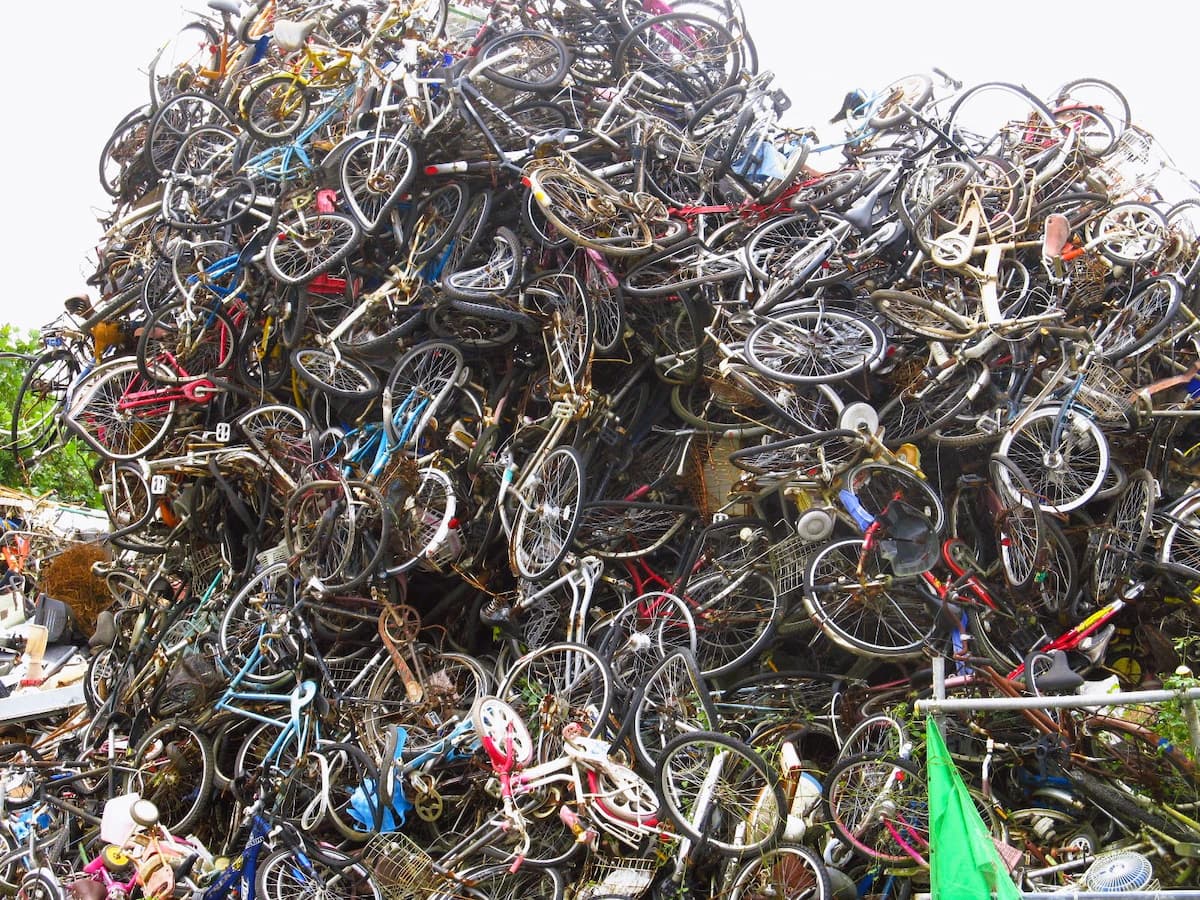
I rode past this astonishing mountain of discarded bicycles while cycling across Kyushu.
At first glance, it looked like a recycling center. But the longer I stared, the more it resembled a graveyard.
Thousands of bicycles. Twisted handlebars, bent wheels, rusting chains, faded saddles. Some were clearly beyond repair. But many appeared intact. Frames unbroken. Components reusable. Tires still holding shape. I could not help wondering how many could have rolled another thousand kilometers with a little attention.
The scene made me think about how differently societies view the end of an object’s life.
In Japan, where order and efficiency often prevail, perhaps many of these bicycles had simply reached the point where repair no longer made economic sense. Labor costs are high. New bicycles are relatively affordable. Recycling is systematic. The old is cleared away so the new can take its place.
In other parts of Asia, the fate of these bicycles might have been very different.
In India, dozens of mechanics would descend upon this pile like archaeologists excavating a lost city. Nothing would be wasted. A wheel from one bicycle, a saddle from another, a brake lever from a third. Within days, many of these machines would be back on the road carrying schoolchildren, laborers, farmers, and market vendors.
In Vietnam, Cambodia, or rural China, countless parts would find a second life. In Africa, entire workshops could survive for years on what appears here to be scrap metal.
Yet perhaps the most striking thought is that every bicycle in this pile once belonged to someone.
A child learning to ride.
A student cycling to school.
A worker pedaling to a train station every morning.
A retiree exploring country roads.
A traveler setting off on an adventure.
Every scratched frame and worn saddle carries an invisible story.
Some bicycles may have traveled only a few kilometers from home. Others may have crossed prefectures, climbed mountain passes, or followed coastlines in the salt air. They carried groceries, dreams, disappointments, first dates, daily routines, and quiet moments of freedom.
Standing before this mountain of discarded machines, I found myself wondering not about the steel and rubber, but about the people.
What journeys ended here?
What roads did they follow?
What stories would they tell if bicycles could speak?
Looking at this bicycle graveyard, I realized that what appears to be a heap of scrap is also an archive of forgotten lives, stacked wheel upon wheel, frame upon frame, waiting to be melted down and turned into something new.