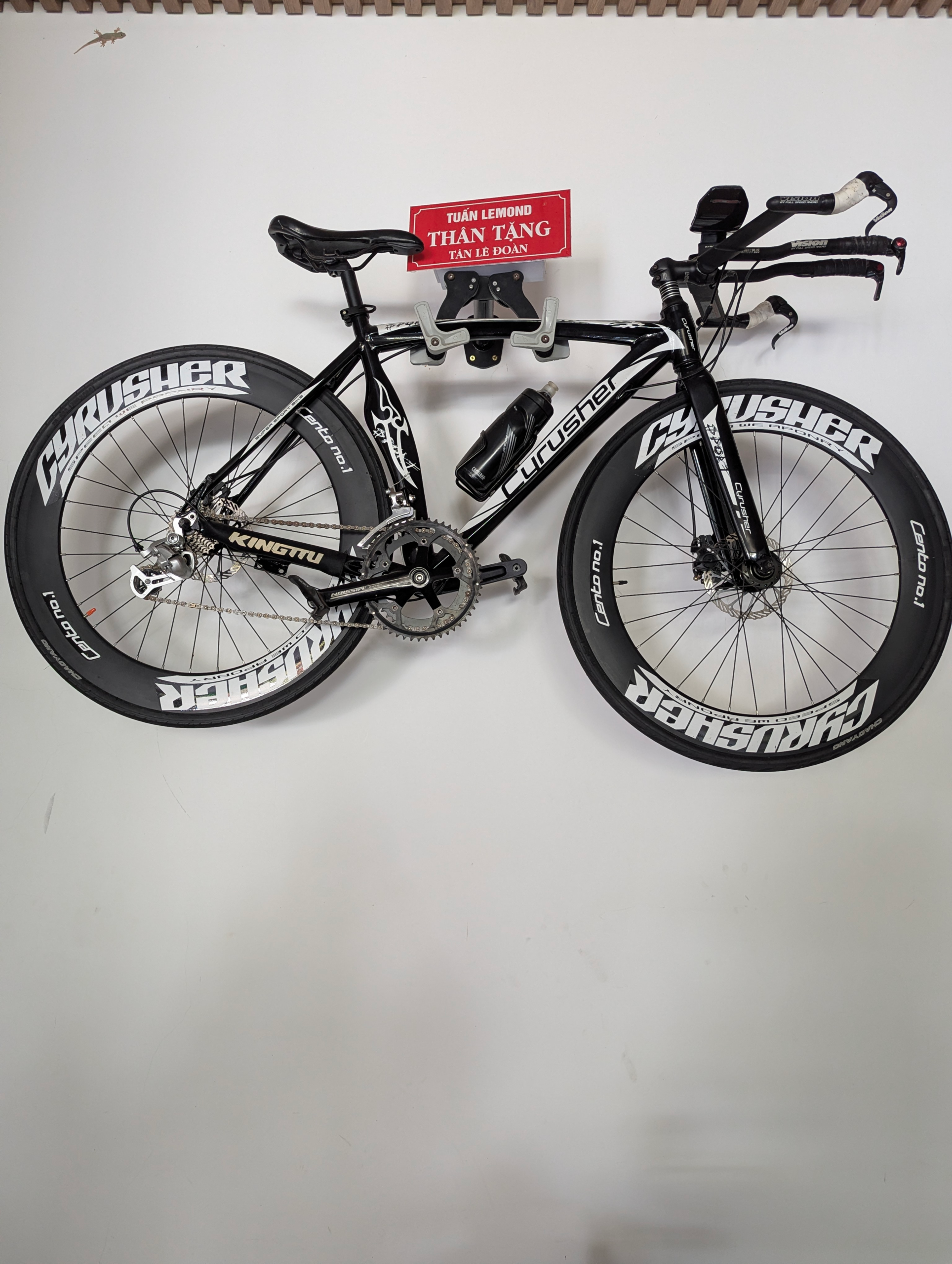
There are moments in travel when something small—almost incidental—opens a door into a much larger story.
I found one of those moments in the lobby of a modest hotel in Rạch Giá, a provincial city on Vietnam’s southwestern coast along the Gulf of Thailand. Once the capital of Kiên Giang Province, Rạch Giá today is a quiet, functional place—more a gateway to islands like Phú Quốc than a destination in itself.
Yet there, on the wall of the Lê Đoàn Hotel, hung a bicycle that stopped me in my tracks.
It was labeled simply as a gift.
A Cyrusher “Crusher” bicycle.
And according to the small sign mounted beside it, it had once been ridden by Greg LeMond, three-time winner of the Tour de France.
A Ride Across Vietnam
In 1998, more than two decades after the end of the Vietnam War, Greg LeMond took part in a remarkable journey: a 2,000-kilometer ride from Hanoi to Ho Chi Minh City.
The purpose was not competition.
It was reconciliation.
The ride was organized by World T.E.A.M. Sports, an organization dedicated to inclusive athletic events, bringing together people of different abilities and backgrounds. LeMond himself served on its board.
Roughly one hundred participants joined the journey—American veterans and Vietnamese veterans riding together, many of whom had once stood on opposite sides of the conflict.
It was not a typical cycling tour.
Among the riders were disabled athletes, some using hand-powered bicycles after losing limbs in the war. Blind riders rode tandem, trusting their partners to guide them forward.
It was, by all accounts, an extraordinary undertaking—not just physically, but emotionally.
The Long Road to Healing
The ride was later documented in the Emmy Award-winning film Vietnam: Long Time Coming, which captured not only the physical journey across the country, but also the emotional weight carried by the participants.
Men who had once faced each other as enemies now shared the road.
Kilometer after kilometer, something shifted.
Cycling, in its simplest form—pedaling forward, side by side—became a vehicle for something far more complex: understanding, forgiveness, and healing.
LeMond’s presence brought visibility to the ride, but the deeper significance lay in the collective experience of the group.
This was not about winning.
It was about moving forward.
A Bicycle Far From the Spotlight
And now, decades later, one of those bicycles hangs quietly on a wall in Rạch Giá.
Not in a museum.
Not behind glass.
Just there, in the lobby of a provincial hotel, where guests pass by without necessarily knowing the story behind it.
The contrast struck me.
Outside, Vietnam has transformed dramatically since the 1990s—modern roads, growing cities, the constant hum of motorbikes replacing the slower rhythms of bicycles.
Inside, this bike remains as a quiet reminder of a different journey.
A journey not defined by speed or distance, but by meaning.
Reflections from the Mekong
Traveling through the Mekong Delta on this recent trip, I often found myself thinking about change—how Vietnam has evolved, how its landscapes and cities have shifted over time.
But standing in front of that bicycle, I was reminded that not all journeys are measured in kilometers.
Some are measured in what they leave behind.
A bicycle on a wall.
A story of former enemies riding together.
And a reminder that sometimes, the most important journeys are the ones that bring people closer—long after the road itself has ended.
#Vietnam #CyclingHistory #GregLeMond #MekongDelta #TravelStories #FootlooseTravelGuides