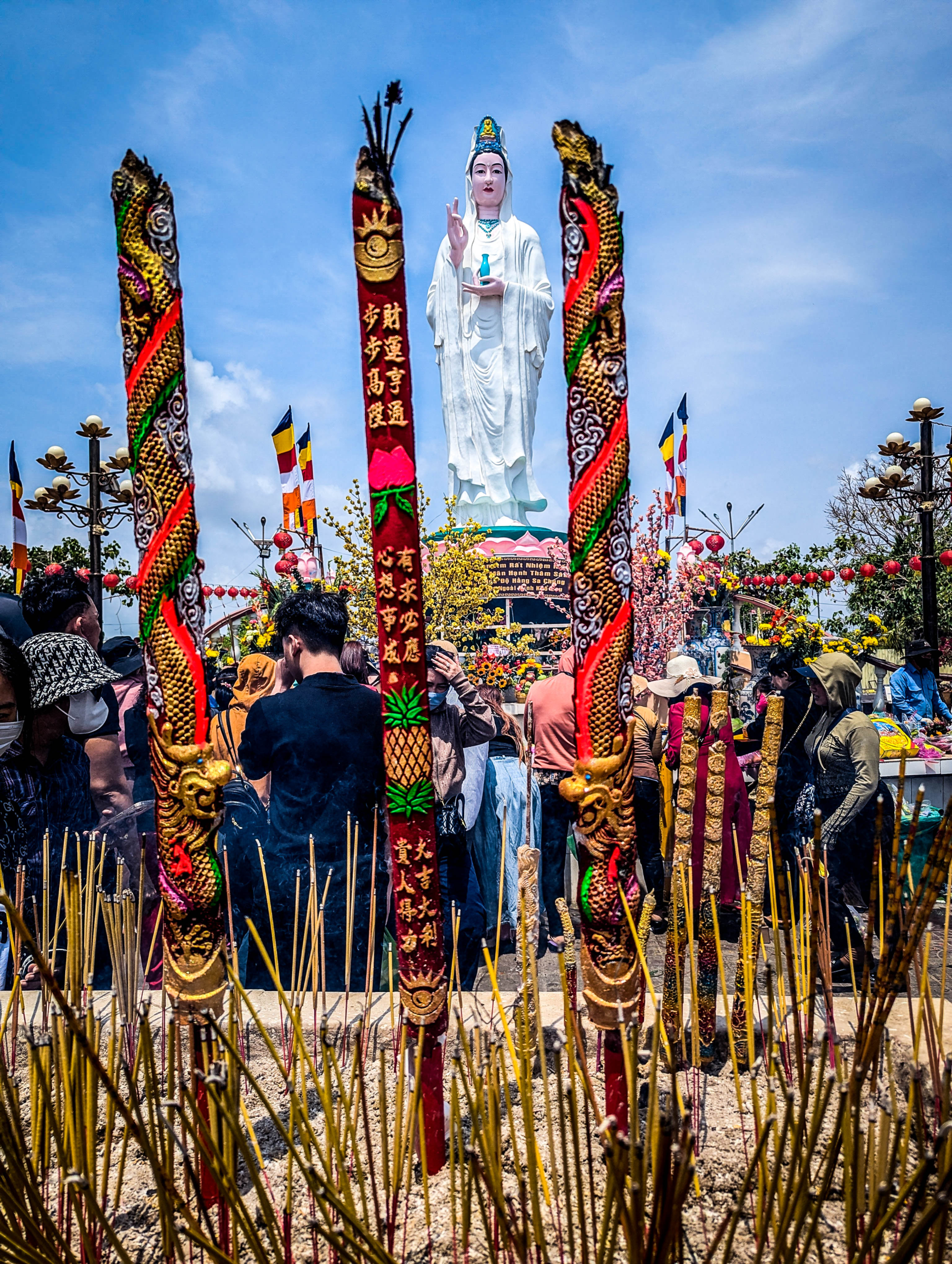
There are places in Vietnam where belief feels immediate—unmediated by explanation, doctrine, or even language. You arrive, you stand quietly among others, and you understand something simply by being there.
Quan Âm Phật Đài, which I visited on my recent journey through the Mekong Delta, is one of those places.
I came here not as a casual visitor, but accompanying members of my Vietnamese family. For them, this was not a sightseeing stop. It was a place of prayer.
At the center of the site stands an imposing figure: Quan Âm, the goddess of mercy, gazing outward over the sea and the lives of those who come to seek compassion, protection, and guidance.
The Site and Its Setting
Quan Âm Phật Đài is located near the coast, not far from Bạc Liêu, where land and water blur into one another across the wide delta. The statue itself rises high above the surrounding grounds—white, serene, unmistakably present.
Pilgrims arrive throughout the day. Some come with incense. Others bring offerings. Many simply stand, hands folded, eyes closed.
The site, as it exists today, is relatively modern—developed and expanded in recent decades—but its spiritual roots run much deeper, tied to long-standing devotional practices centered on Quan Âm throughout Vietnam and across East Asia.
Who Is Quan Âm?
To Vietnamese Buddhists, Quan Âm (Quan Thế Âm Bồ Tát) is the embodiment of compassion.
Often referred to as the “Goddess of Mercy,” she is believed to hear the cries of the world and respond to those in suffering. In Chinese she is known as Guanyin, in Japanese as Kannon—all derived from the Sanskrit name Avalokiteśvara, a bodhisattva in Mahayana Buddhism.
Traditionally, Avalokiteśvara was depicted as male in early Indian Buddhism. But over centuries, as Buddhism spread into China and then Vietnam, the figure gradually took on a female form, becoming more closely associated with maternal compassion.
This is why in Vietnam you may hear Quan Âm described as:
- a female Buddha,
- or even as the “Buddha mother.”
Strictly speaking, she is not a Buddha in the doctrinal sense, but a bodhisattva—an enlightened being who chooses to remain in the world to help others rather than enter final nirvana.
But in lived belief, those distinctions matter less.
To those who come to pray, she is simply the one who listens.
Mahayana and Hinayana: Two Paths
Understanding Quan Âm also means understanding the broader context of Buddhism in Vietnam.
Buddhism is not a single unified system, but a family of traditions. Two of the most commonly referenced branches are:
Hinayana (Theravāda Buddhism)
- Practiced primarily in countries like Thailand, Cambodia, Laos, and Sri Lanka
- Focuses on individual enlightenment
- Emphasizes monastic discipline and the historical Buddha
- The ideal figure is the arhat, one who attains liberation through personal effort
Mahayana Buddhism
- Practiced in Vietnam, China, Japan, and Korea
- Emphasizes compassion and the salvation of all beings
- Introduces bodhisattvas like Quan Âm
- The ideal is not only personal enlightenment, but helping others achieve it
Vietnam, particularly in the north and much of the south, follows Mahayana Buddhism, which explains the central role of figures like Quan Âm.
Yet in the Mekong Delta—especially closer to Cambodia—you will also find Theravāda (Hinayana) temples, reflecting the region’s cultural and historical diversity.
The two traditions coexist, often without tension, each shaping the spiritual landscape in different ways.
Faith Under a Communist State
Vietnam is officially a socialist state, and like other communist countries, it historically maintained a cautious, often restrictive stance toward religion.
Yet Vietnam today presents a more nuanced reality.
Both Buddhism and Christianity are practiced openly, though within a framework of state oversight. Religious institutions are recognized, managed, and at times subtly guided by the government.
In practice:
- Temples are active and well attended
- Churches are visible and functioning
- Major religious festivals take place publicly
At Quan Âm Phật Đài, there was no sense of suppression.
People came freely, prayed freely, and moved through the space with quiet confidence.
If anything, what stood out was not restriction—but continuity.
The Presence of Chinese Temples
During this recent journey, I noticed something else.
Across the Mekong Delta—and even in Saigon—there seemed to be a growing number of Chinese-style temples.
Bright, ornate, filled with incense and intricate carvings, these temples stand apart visually from traditional Vietnamese pagodas.
It raises a natural question:
Are these truly new?
Or were they always there?
The answer is both.
Southern Vietnam, particularly areas like Chợ Lớn in Ho Chi Minh City, has long been home to a significant ethnic Chinese (Hoa) community. Many temples date back generations, even centuries.
However, in recent years, several factors have contributed to a renewed visibility and expansion:
- Economic growth, allowing restoration and construction
- Overseas Vietnamese and Chinese diaspora funding
- A broader cultural openness that encourages religious expression
So while not entirely new, these temples are often newly restored, expanded, or more prominent than they might have been in earlier decades.
They reflect not only faith, but also the layered cultural identity of southern Vietnam.
A Quiet Moment of Understanding
Standing at Quan Âm Phật Đài, watching people come and go, I found myself returning to a simple thought.
You do not need to fully understand the theology to understand the place.
You see it in the gestures:
The bowed heads.
The incense smoke rising.
The quiet conversations with something unseen.
In a region shaped by history, hardship, and constant change, the presence of Quan Âm—the one who listens—feels both timeless and immediate.
And perhaps that is why people keep coming.