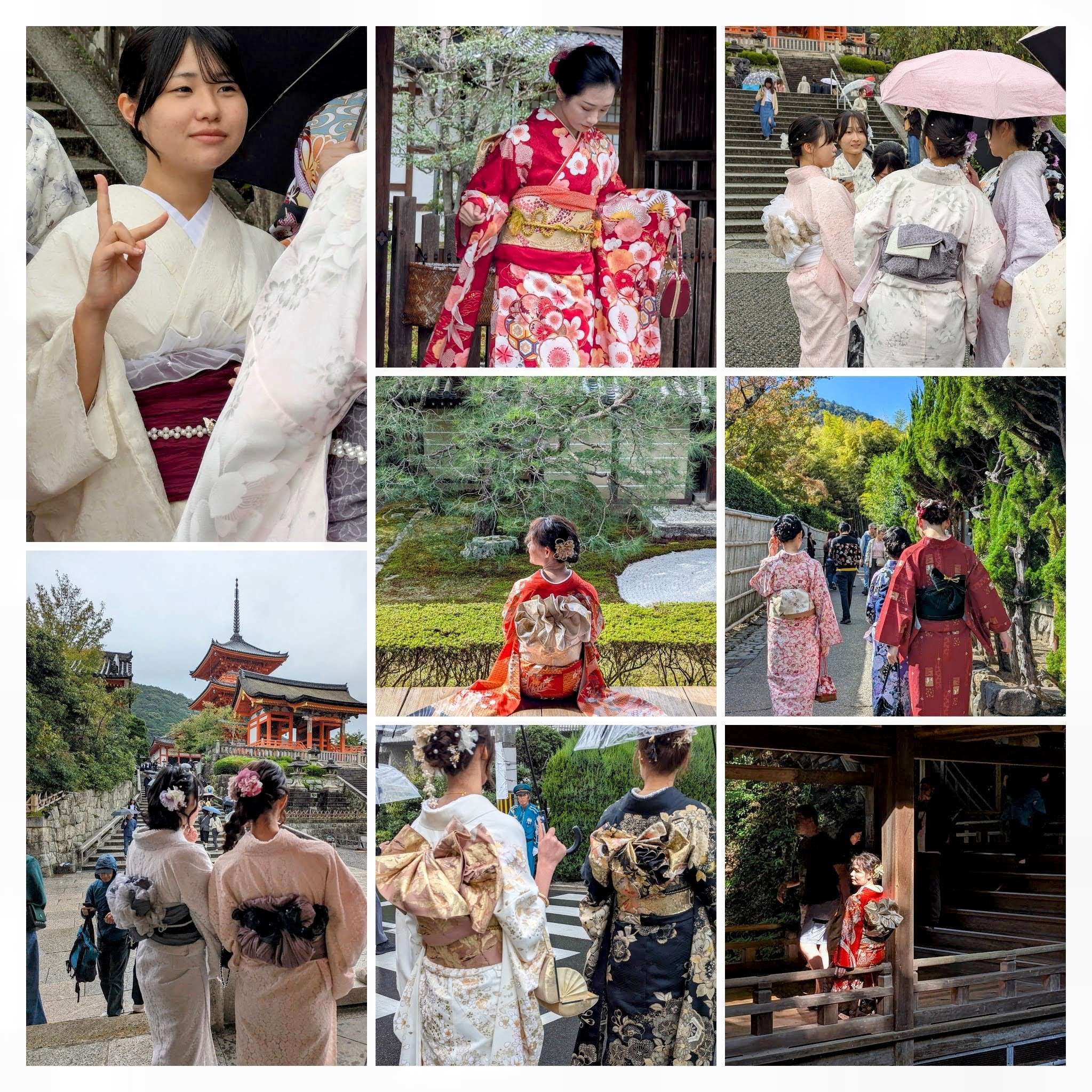
Walking through Kyoto, especially around temple districts like Kiyomizu-dera, Gion, or the Higashiyama slopes, you will almost certainly encounter young women dressed in elaborate kimono. They stroll, pose for photos, laugh with friends, and move through temple precincts as if they belong to another era.
To the uninitiated visitor, it’s tempting to assume they are geishas.
They are not.
What you are seeing is a modern Japanese phenomenon: kimono rental culture. Mostly domestic tourists—often young women, couples, or small groups of friends—rent kimono for a few hours or a day as part of their Kyoto experience. Rental shops are everywhere, offering not only kimono but hairstyling, accessories, and even guidance on how to walk and pose.
The appeal is layered. For some, it’s playful and social. For others, it’s nostalgic or aesthetic. And for many, it’s simply a way to slow down, inhabit a different rhythm, and experience Kyoto more consciously. Walking in kimono changes posture, pace, and awareness—steps become shorter, movements more deliberate.
This is not costume in the Western sense, nor is it cosplay. It is a form of participatory tradition, a voluntary performance that blends tourism, fashion, and cultural continuity.
Geishas—more accurately geiko in Kyoto—are something else entirely. They are professional artists trained for years in music, dance, and conversation, and they move within highly regulated social worlds. Encounters with real geiko are rare, brief, and often misunderstood. The kimono-clad tourists wandering temple grounds are not attempting to imitate them.
What makes the scene interesting is not authenticity in the strict sense, but intent. These young women are not pretending to be someone else. They are choosing to experience place differently, on their own terms. In a city often overwhelmed by international tourism, this practice is strikingly domestic, intimate, and self-directed.
As a visitor—especially one passing through Kyoto slowly, on foot or by bicycle—it’s worth pausing to observe this dynamic without judgment. Kyoto is not a museum frozen in time. It is a living city where tradition is constantly reinterpreted, sometimes lightly, sometimes earnestly.
Seeing kimono worn this way is less about looking backward than about negotiating the present—finding moments of beauty, ritual, and play within a modern life.
Learn more about the Nakasendō, wandering Kyoto and Nara on foot and by bike, and returning east along the Tōkaidō, cycling the Old Roads of Japan.