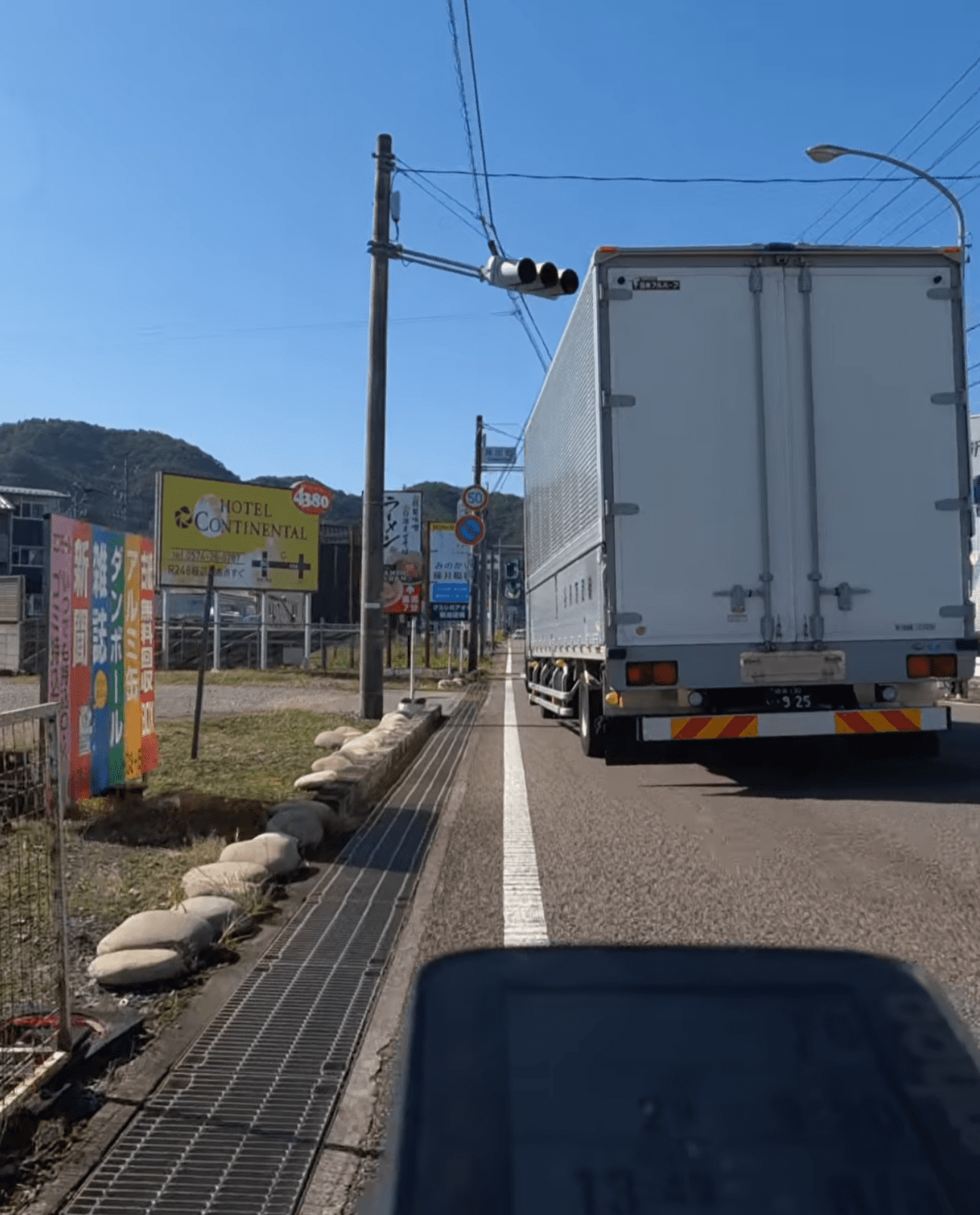
Some cycling days in Japan unfold quietly, following rivers through wooded valleys or slipping past villages barely awake. Others are defined less by scenery than by negotiation—with traffic, infrastructure, and your own tolerance for stress.
The stage from Minokamo to Gifu-Hashima, much of it paralleling the Kiso River, belongs firmly in the latter category.
On paper, it looks benign. The route trends gently downhill, the river offers open views, and historic Inuyama Castle lies along the way. But riding here today means sharing space with a constant stream of traffic—far more trucks than passenger cars—moving fast, close, and with little margin.
As the video shows, much of the riding happens on narrow shoulders or faded edge lanes. When the pressure becomes too much, the only escape is often the sidewalk—technically shared-use, but frequently overgrown with weeds, broken by curbs, or interrupted altogether. The choice becomes a familiar one: stay in traffic and tense up, or retreat to the sidewalk and accept slow, awkward progress.
This is not an isolated experience. It’s emblematic of what cycling the Nakasendō corridor often means today once you leave the preserved post towns behind. The historic road still exists in spirit, but the physical reality has been reshaped by modern logistics and industry. The river that once carried goods now parallels roads that move them faster, heavier, and in far greater volume.
And yet, moments still surface. A sudden glimpse of the river widening. The silhouette of Inuyama Castle rising above the trees. A brief stretch of quieter pavement that reminds you why you’re out here at all.
I share this stage not to discourage, but to be honest. Cycling Japan is not uniformly idyllic. Some days demand patience more than strength. Knowing that in advance helps you pace yourself—mentally as much as physically.
This stage, and others like it, are part of the broader story I tell in my recently published guide to cycling the Nakasendō and Tōkaidō. It’s a story of old roads that survive in fragments, of choices between romance and realism, and of learning when to push on—and when to roll past without stopping.
If you’re planning your own ride through Japan, or simply curious what cycling these historic corridors looks like today, I hope this glimpse adds clarity to the picture.